[Beyond DUNIA] Do Women’s Movements Exist in Southeast Asia?
![[Beyond DUNIA] Do Women’s Movements Exist in Southeast Asia?](/content/images/size/w1200/2026/01/20.png)
By Jo Goeun (Translator, Administrative Specialist)
We often encounter critiques pointing out that Vietnamese women working in Nike shoe factories, Indonesian women on palm oil plantations, and Filipino women laboring in kitchens across Hong Kong, South Korea, and the rest of the world are exploited through low wages and intense workloads simply because they are 1) Asian and 2) women. However, because these critiques usually reach us through South Korean or Anglo-American media, we tend to know about the injustices they suffer while remaining largely unaware of the voices, perspectives, and actions of the women themselves.
As a result, we unconsciously construct a narrative in which Asian women are portrayed merely as passive victims of injustice—people who do not criticize or resist their conditions—while those who recognize and problematize their exploitation are “us,” namely people in South Korea or the English-speaking West.
The idea that Asian women endure discrimination and exploitation without even recognizing its injustice is a form of Orientalism that is both racist and misogynistic. And when encountering other Asian women, Korean women are not necessarily free from this Orientalist gaze either. If this discriminatory perspective rests on the assumption that “Asian women are backward or premodern,” then the “we” who observe them are implicitly positioned as Westernized, modern, and enlightened. This Orientalist mindset thus materializes in two directions: first, “Women in other parts of Asia today must be backward,” and second, “Women in Korea in the past must have been backward as well.”
Women Who Fought, Just Like Us, Have Always Existed Everywhere
Escaping this mindset is surprisingly simple: get closer to their lives and listen directly to their voices. With just a bit of effort, we can learn how women in the Joseon Dynasty sharply criticized patriarchal married life through song; how women during the colonial period actively called for women’s liberation through reading groups and independence movements; and how, after liberation, women filled the streets demanding an egalitarian family system—abolishing class hierarchy and concubinage—in order to build a democratic republic free from status and class discrimination.
The reason we must deliberately “make an effort” to discover such fascinating histories is that the histories of marginalized people are quickly erased. The progressive achievements they forged are often absorbed, during processes of documentation and evaluation, into the accomplishments of reformist male leaders or “enlightened” American missionaries and the U.S. military government—in other words, into the achievements of male-dominated power structures.
The Fighting Ibu of Indonesia
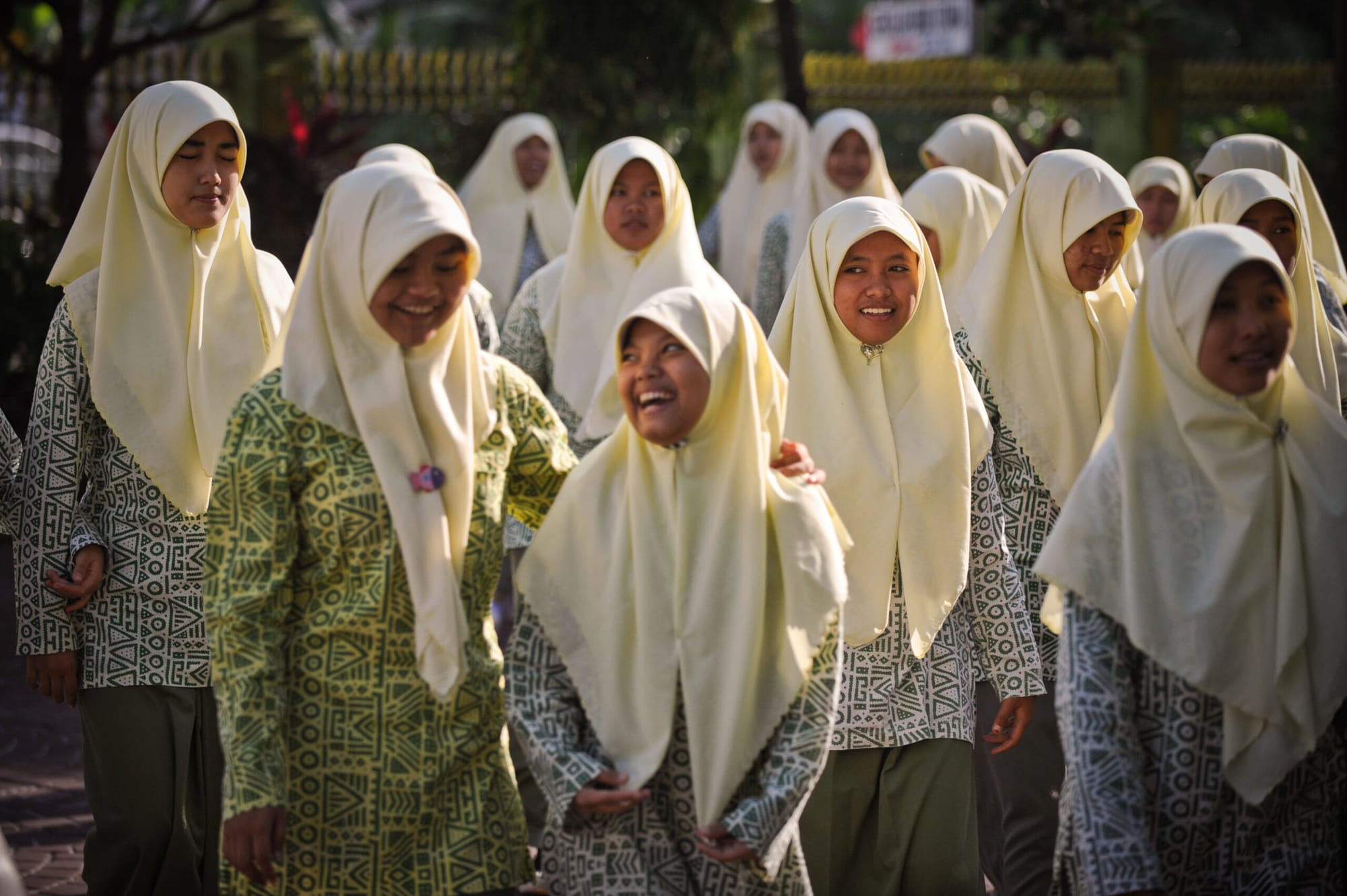
The same holds true for Indonesian women. Although the 1998 democratization movement that toppled Suharto’s 32-year dictatorship (1967–1998) drew global attention, it has largely been recorded and analyzed merely as the outcome of mass protests sparked by student-led anti-government demonstrations amid the Asian financial crisis. Yet at the forefront of that movement stood a women’s movement called Suara Ibu Peduli (SIP, “Voices of Concerned Mothers”).
There were complex reasons why women inevitably took center stage in the anti-Suharto movement. For years, the Suharto regime had promoted the image of the “gentle mother” as a governing strategy to induce public compliance, while simultaneously demonizing communists as enemies of the state by spreading images of female communist militants who brutally murdered national heroes. As low-wage labor exploitation and elite corruption plunged everyday life into extreme poverty, children—unable to secure even basic meals—were the first to face life-threatening conditions.
At the intersection of misogyny as a tool of governance, extreme labor exploitation, and severe poverty, SIP feminists found themselves unable to retreat any further. In February 1998, despite strict military security measures, they launched protests chanting “Lower the price of milk (Down SuSu).” The slogan was cleverly designed to carry a double meaning: susu (milk) and Su (Suharto). On the surface, it framed the protest as “gentle mothers” worrying about their children, thereby depriving the state of justification for repression; at a deeper level, it galvanized broad public support from those who sought the downfall of the regime.
Even after the democratization movement expanded nationwide, SIP continued to support protesters by establishing public kitchens funded by donations from supporters of the “Lower the Price of Milk” campaign. These kitchens also functioned as public forums, becoming discursive and organizational hubs for the movement. Over time, however, SIP’s resistance to state violence, economic inequality, and misogyny under dictatorship was reduced in historical evaluations to a mere “poverty movement” of women worried about strained household finances.
This process closely mirrors how women’s movements in Korea—within the independence movement, nation-building efforts, the labor movements of the 1980s, and the 1987 democratization movement—have similarly been relegated to secondary importance. Yet Indonesian feminists were among those who felt the social consequences of Suharto’s dictatorship most acutely and who took the lead in bringing the regime down.
Women Who Find the Women Who Fight
When we begin to uncover the histories of Asian women long assumed to have been merely exploited, we also discover that there have long been women dedicated to excavating and sharing these stories of resistance. The erasure of women’s history thus also means the erasure of the women who documented and studied it.
This realization often leads, for those who engage with women’s issues in Korea, to anger over how such blatant disregard and discrimination have persisted for so long—anger that sometimes turns into resentment or pity toward earlier generations of women, as if they had simply stood by and done nothing. But movements led by marginalized groups are forged through cycles of monumental victories and fierce backlash from the mainstream, and their step-forward, step-back trajectories are repeatedly erased by dominant powers.
Male-centered imperialism has not only exploited Asian women’s labor and sexuality; it has also appropriated their records, histories, and stories. If feminism is a movement to reclaim the capacities and values of women erased by patriarchal society, then the first thing we must do is reclaim one another. Seeking out the histories of women in neighboring Asian countries who live alongside us as “Asian women,” and meeting the women who once sought news of other women just as we do today, can become a profound source of strength.
Together with Asian feminists—and with Dunia.
I still cherish the memory of first taking Professor Choi Hyung-mi’s course Asian Feminism in 2018, when women from Asia—once distant and unfamiliar—suddenly felt close. In a time when countries across the United States, Europe, and Japan are rapidly shifting toward the far right, encountering the independent media outlet Dunia, which seeks to build a multidimensional network connecting Korea and Asia through sustained and analytical reporting on the region, has been a deeply welcome experience. Through a three-part series, I plan to introduce the women who fought across Asia, as well as the women who sought them out before us.
References
Choi, Hyung-mi (2018). A Study on the Politics of Intersectionality in Indonesia’s “Mother’s Movement,” Suara Ibu Peduli. Journal of Women’s Studies, Vol. 35, No. 1, pp. 129–161.
Jo Goeun has translated numerous works on feminism and queer theory and currently works as a certified translation and administrative specialist.