[Beyond DUNIA] Is the Queer Movement Really a Western Invention?
![[Beyond DUNIA] Is the Queer Movement Really a Western Invention?](/content/images/size/w1200/2026/01/20-2.png)
By Jo Goeun (Translator, Administrative Specialist)
Feminism among heterosexual women and queer women, Western women and Asian women
At the Fourth United Nations World Conference on Women held in Beijing in 1995, two significant events unfolded. First, for the first time in the history of the UN World Conferences on Women — initiated in 1975 — a lesbian organization was allowed to operate an official, independent booth. The proposal came from Anjana Suvarna Nanda, founder of a Thai lesbian organization and a key initiator of the Asian Lesbian Network. At the time, the World Conference on Women did not recognize “sexual orientation” or LGBTQ+ rights as legitimate women’s issues. Compounding this exclusion was the fact that the Chinese government, which criminalized homosexuality, actively suppressed lesbian-related events during the conference. In response, Chinese lesbian organizations, gay activists, and even Chinese women participating as government employees or volunteers played a decisive role. Defying a state that criminalized their existence, they protected the lesbian booth throughout the conference, organized a wide range of events, and even staged guerrilla-style actions that were carried out unexpectedly and swiftly.
The second major development was the emergence of strong critiques by Asian feminists — most notably Chandra Talpade Mohanty, an Indian feminist scholar — against Western feminists who sought to universalize their own experiences and “educate” Asian women through Western feminist frameworks. Asian feminists attempted to incorporate an “anti-imperialism” clause into the conference’s final declaration, but disagreements over the concept of imperialism ultimately led to its exclusion. Nevertheless, this conference became a turning point. Asian feminism expanded both in scope and intensity, and within Western feminist historiography, the 1980s and 1990s came to be described as a period of “diversification,” marked by the rise of queer feminism and Third World feminism.
Wherever women exist, women’s movements emerge. Likewise, wherever queer people exist, queer movements also take shape. Western queer movements originated as resistance to the gender binary (male/female) and the heterosexual nuclear family — both products of Western modernity. Western modern societies first divided human bodies into male and female categories, then prescribed appropriate forms of masculinity and femininity for each. Bodies that did not conform were surgically altered to fit one category or excluded as abnormal. Behaviors that deviated from gender norms were disciplined through law, institutions, morality, and emotional punishment, or stigmatized as dangerous and deviant. All of this was presented as natural, inevitable, and rooted in human nature itself.
Yet just as the Western gender binary and heterosexual nuclear family are not universal laws of nature, neither are the gender systems and family structures of Asian societies uniform. They vary widely across regions and cultures. If queer movements are understood solely as resistance to Western systems, then “that” queer movement cannot simply exist in Asia. What exists instead are distinct movements resisting local gender norms and family systems — rooted in different historical and cultural conditions.
Diverse Gender Systems in Indonesia
Indonesia, a republic composed of numerous ethnic groups, has long recognized diverse forms of gender expression across its cultures. Terms such as wandhu (Javanese), calalai (Napierese), and banci (Malay) refer to genders beyond the male-female binary, indicating that many communities did not historically limit gender to two categories. Among the Bugis people, Bissu—individuals who are neither male nor female—served as spiritual intermediaries and representatives of the divine. In the Ponorogo region, traditions existed involving warok, male warriors, and gemblakan, male dancers. In Java, female couples known as sentul and kantil were also part of social life.
Each ethnic group developed its own gender systems and family structures, along with their own internal orders and tensions. Indonesian society, marked by deep ethnic and cultural diversity, was largely unfamiliar with Western categories such as “gay” and “lesbian,” yet relatively accustomed to gender diversity. Modern LGBTQ+ activism in Indonesia began in 1969 with the formation of the first Waria organization in Jakarta (Waria referring to male-assigned individuals who present as women, often understood today as MTF transgender). Though a minority, Waria were not primary targets of social hatred or exclusion at the time, and they encountered relatively little difficulty in receiving government support. During the 1980s, gay and lesbian groups also formed organizations, expanded networks, and actively advocated for LGBTQ+ rights.
The Crisis of LGBTQ+ Rights in Indonesia
From the late 1980s onward, however, women’s and LGBTQ+ rights came under serious threat due to a convergence of factors. In 1988, Indonesia’s first reported AIDS case involving a gay man triggered the spread of an American-style moral panic: the notion that gay men were carriers of disease. This rhetoric gained traction even in a society that had previously shown limited hostility toward homosexuality. Following the collapse of Suharto’s long dictatorship, the Habibie administration, while promoting democratization, simultaneously sought to consolidate public support by scapegoating ethnic Chinese Indonesians for the country’s economic crisis. Anti-Chinese sentiment intensified, and sexual violence against Chinese Indonesian women surged—yet the government largely turned a blind eye. After the September 11 attacks, the U.S. Bush administration’s aggressive anti-Islam policies contributed to the global consolidation of extremist fundamentalist movements. In Indonesia, where Islam is the dominant religion, this shift was particularly visible in Aceh, where fundamentalist groups began violently repressing women and LGBTQ+ communities.
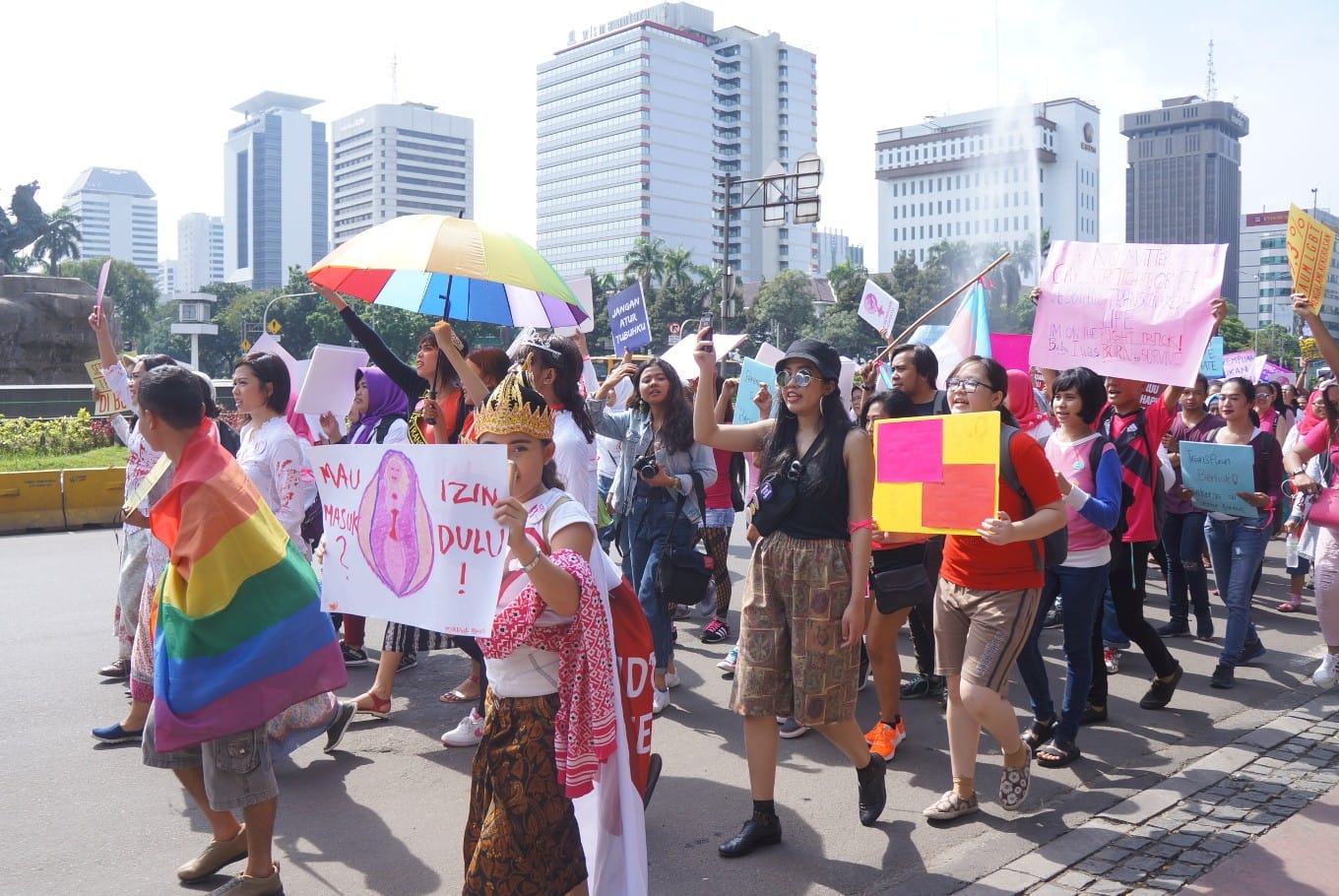
Amid these domestic political shifts and international pressures, repression intensified. Lesbian organizations, facing compounded discrimination as women and as sexual minorities, became increasingly reluctant to engage publicly or form alliances with other LGBTQ+ groups. Attempts to establish umbrella organizations or host conferences were frequently met with threats from radical Islamist groups and government indifference. Yet repression also produced resistance. Around 2010, nationwide LGBTIQ forums and regional GWL organizations responding to HIV/AIDS emerged across Indonesia.
Alliances between women’s movements and LGBTQ+ groups grew stronger, rooted in shared experiences of coercive heterosexual marriage, religious violence, physical assault, and systematic state neglect. Feminists, agricultural workers, factory laborers, and women active across diverse social movements—both as community members and as allies—worked to integrate LGBTQ+ rights into broader democratic struggles. Still, marriage-centered repression remains entrenched. Beginning in 2026, new laws criminalizing premarital sex and cohabitation will further endanger the lives of women and sexual minorities. At the same time, resistance is intensifying. Amid nationwide protests demanding political reform and labor rights in response to the incompetence and conservatism of the Subianto administration, struggles for LGBTQ+ rights are entering a decisive historical moment—one that underscores the urgency of international solidarity.
References
Pilwha Chang & Myungseon Lee (eds.) (2015), Our Voices 1, Ewha Womans University Press.
Pilwha Chang & Myungseon Lee (eds.) (2016), Our Voices 2, Ewha Womans University Press.
Hyungmi Choi, “Marginalized and Isolated Sexual Minorities… The Need to Challenge Enforced Heteronormativity,” Women’s News, 2016.
Jo Goeun has translated numerous works on feminism and queer theory and currently works as a certified translation and administrative specialist.