GIJC 2025: Wherever They Are, Investigative Journalists Are Not Alone
“For the traditional generation of ‘lone-wolf investigative journalists’, securing collaborative partners has become essential in order to confront vast big data.” — from a 2014 article by the International Consortium of Investigative Journalists (ICIJ)
There is a term, “lone wolf.” According to the Merriam-Webster dictionary, it refers to “a person who prefers to work, act, or live alone.” In Anglophone literature and international news, the phrase is often used to describe detectives, private investigators, or individuals who become terrorists as a result of social isolation.
In the world of journalism, a “lone wolf” usually refers to an investigative reporter who, alone, exposes wrongdoing by those in power or by large interest groups, or to a war correspondent reporting from the front lines. The term carries both admiration and stereotype. There is admiration for someone who fights a long and difficult battle “alone,” and at the same time a preconceived notion that this person is a somewhat proud figure who chooses solitude on the basis of exceptional know-how and a unique world of experience. In essence, the lone-wolf reporter has long served as a metaphor for a “solitary seeker of truth.”
The End of the “Lone-Wolf” Era
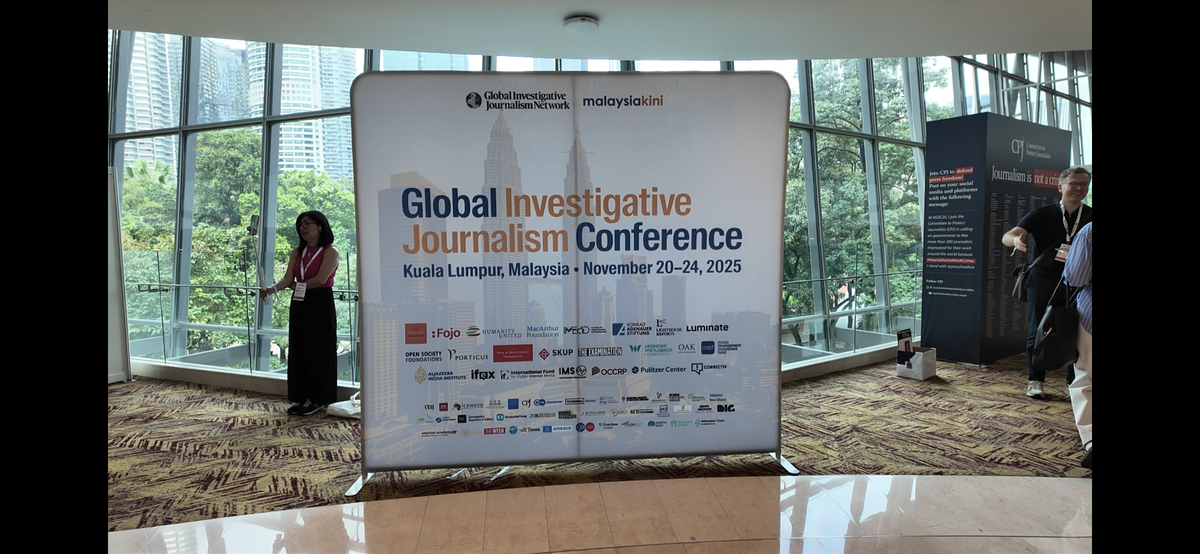
From November 20 to 24, 2025, the Global Investigative Journalism Conference was held in Kuala Lumpur, the capital of Malaysia. About 1,500 “solitary seekers of truth” from 135 countries flew in and gathered at the Kuala Lumpur Convention Centre (KLCC).
Now in its 14th edition, the conference brought together journalists and news outlets that have been doing investigative reporting or intend to do so, as well as for-profit and nonprofit organizations that fund or support investigative journalism. Through more than 150 sessions, participants exchanged ideas, shared know-how, and developed collaborative reporting concepts.
From South Korea, three newsrooms took part: the Korea Center for Investigative Journalism (KCIJ)-Newstapa, the newly launched nonprofit independent outlet Dunia, and the weekly news magazine SisaIN.
The Global Investigative Journalism Conference is an international gathering of investigative journalists from around the world. Since the first conference was held in Copenhagen, Denmark, in 2001, it has been held in Amsterdam (2005), Toronto (2007), Lillehammer (2008), Geneva (2010), Kyiv (2011), Rio de Janeiro (2013), Lillehammer (2015), Kathmandu (2016), Johannesburg (2017), Seoul (2018), Hamburg (2019), online (2021), and Gothenburg (2023). This year marked the third time it has been held on the Asian continent.
Over four days, field reporters, editors, and members of media support organizations shared:
- Experiences and models of cross-border collaborative investigative journalism
- Data- and technology-driven journalism and investigative techniques
- Survival strategies in environments where press freedom is under threat (exile media, safety and security in reporting)
- Sustainable journalism models (new media, independent media, nonprofit and collaborative models)
- Reporting know-how on public-interest issues such as corruption, financial crime, human rights, the environment, climate, and climate-related crime
The themes I followed most closely were collaborative models and climate.
Seven Sessions On Collaboration and Climate
I attended seven sessions dealing specifically with collaboration and climate. The reporting themes were public health, the environment, and the climate crisis. I also attended a session on undercover reporting featuring KCIJ-Newstapa, and a screening of the documentary film Search & Seizure.
Among the sessions, the two that were most impressive and practically useful were the ones on environmental crime investigations and on reporting about carbon offsets. Both introduced investigations that would not have been possible without collaboration between expert communities (scientists, researchers, legal professionals) and cross-border teams of investigative journalists.
At a pre-conference on November 20 titled “Investigating Global Health,” I attended two sessions:
- “From Big Corporations to Backyards: Telling Stories About Climate Change as a ‘Here-and-Now’ Public Health Issue”
- “Finding Your People: Strategies for Global Health Audiences”
There, I came across unexpected, useful techniques and collaboration ideas. In the session on framing climate change as an immediate public health crisis, the pan-Arab news platform Daraj Media (founded in 2017) and the Italian cross-border freelancers’ alliance FADA Collective (founded in 2020) shared long-term investigative reporting from the Middle East on how oil companies’ drilling activities have harmed local communities’ health and environment.
The most crucial element in these investigations was finding credible, independent medical experts to collaborate with. What decided the success or failure of the reporting, however, was building empathy with local residents and maintaining long-term relationships with them.
Making Invisible Environmental Crime Visible
In the case of Daraj Media, the outlet investigated how multinational oil, gas, and energy companies such as BP (British Petroleum), headquartered in the UK, and Shell, a global energy company with Dutch roots and headquarters likewise in the UK, had engaged in flaring for more than a decade in Iraq, Tunisia, and Egypt.
Gas flaring is the practice of burning methane and converting it into carbon dioxide and other compounds. It has no distinct smell or color, and in some cases produces no visible smoke, which makes it difficult to detect even when released into the air. Daraj documented the consequences through evidence of increases in respiratory and cardiovascular diseases, preterm births, and other reproductive health problems among local residents.
Hala Nouhad Nasreddine, head of the investigative team at Daraj Media, who spoke at the session, said:
“It’s important to ‘personalize’ invisible environmental crimes by showing how they have affected individuals.”
FADA Collective shared a four-year investigation into how oil drilling has exacerbated water scarcity in Iraq and affected people’s lives. The team traced drought and pollution of rivers back to the activities of major oil companies, including Exxon (United States), Lukoil (Russia), BP (United Kingdom), and ENI, Italy’s largest oil company.
Oil extraction requires large quantities of water, and these companies drew freshwater directly from the Tigris and Euphrates rivers.
Sara Manisera, a freelance investigative journalist with FADA Collective who presented at the session, said:
“If there is a water crisis in Iraq, I wanted to explain that it’s because of economic decisions made on the ground by oil companies that chose ‘profit over life.’ We interviewed more than 40 people, including workers, medical experts, government officials, residents, and activists.”
Thanks to the close, long-term relationships built on the ground over four years, the reporters were able to:
▲ Access medical records inside a pediatric cancer hospital, and ▲ Obtain, via the agriculture ministry, a confidential local government report written by the governor of Maysan Province in southern Iraq on the impact of oil drilling on rivers.
These long-term collaborations made it possible to demonstrate the negative impact oil companies had on residents’ health and on rainfall patterns. Because the investigation, which began in 2022, took four years, the reporters had to work part-time and secure additional income sources to sustain their reporting.
How to Report on Carbon Offsets
On November 22, I attended a session titled “How to Report on Carbon Offsets.” It focused on investigative reporting methodologies for exposing conflicts of interest in the voluntary standards that underpin carbon credit trading schemes designed to achieve carbon neutrality.
Carbon credit certification bodies such as Verra, Gold Standard, American Carbon Registry, and Climate Action Reserve all operate as international or U.S.-based voluntary standard-setting entities. They certify carbon credits at both the corporate and project level. The key message of the session was that it is essential to closely examine whether there are conflicts of interest with auditing entities, or any links to human rights violations or environmental destruction. (The South Korean government’s overseas carbon credit acquisition programs rely on Verra certification.)
Again, the emphasis of this session was on cross-border collaboration between journalists and experts such as accountants and lawyers.
Leila Goldstein, a freelance investigative journalist based in Cambodia, explained that because the subject matter is inherently theoretical and requires sifting through a large volume of audit reports and other documents:
“It’s really important to find experts who can offer metaphors and analogies that readers can understand. That’s what makes the story vivid.”
Andreas Bermudez Lievano, a journalist with the Latin American investigative team EL CLIP, based in Costa Rica, stressed the importance of legal collaboration:
“Whenever you write about carbon credits, always, absolutely always, have a lawyer by your side to review the piece. I’ve never seen a field as aggressive in terms of legal threats as environmental reporting, because we are touching money in an unregulated market.”
Bagja Hidayat, deputy editor of the Indonesian newsweekly Tempo, said that in order to verify corporate land concessions and logging rights that are not publicly disclosed, collaboration with government insiders is crucial. He added:
“Indonesian journalists believe that behind every criminal organization and illegal activity, there is always at least one person who feels a sense of unease. We believe we can collaborate with them to obtain information and documents.”
The Unfinished Journey of the “Lone Wolves”
In 14 years as a reporter, this was the first time I had been in the same place with so many journalists at once. It was also my first opportunity to meet, in one setting, reporters and editors I had known for a long time, senior journalists I had only heard stories about, and reporters and editors whose bylines made me think, “I’d like to meet them someday.”
What surprised me most was realizing that during the years I believed I was continuing field reporting alone, some journalists were meeting every year or every other year to share story ideas, to put their heads together to find breakthroughs in investigations that seemed impossible, and to figure out ways to fund their reporting.
At moments, simply knowing that such a network existed—and that one could gain access to it—felt like a privilege. The conference fee alone was USD 380, and without sponsorship, participants must cover transportation, food, accommodation, and other living expenses out of their own pockets.
“Why hold a global investigative journalism conference if you’re just going to fill it with people from the Global North who can afford to pay their own way? If I were the Global Investigative Journalism Network, I’d use the money spent sponsoring journalists from the Global North to bring more reporters from Asia and Africa.”
I heard this loud, angry male voice during a break at the pre-conference on November 20.
Later that evening, at the welcome reception, I was introduced to the man behind that voice by Kim Yong-jin, collaboration editor at Newstapa. It turned out to be Mark Lee Hunter, the journalist who authored Story-Based Inquiry: A Manual for Investigative Journalists, an investigative reporting manual published by UNESCO.
Despite embodying the traditional image of the proud, solitary “lone wolf,” Hunter was, in fact, one of the founders of the Global Investigative Journalism Network. From the founder’s perspective, it seems he was deeply dissatisfied that the panels at this 14th conference were still composed mostly of people from the Global North.
At that moment, I found myself thinking about the “lone wolves” in Asia who still cannot reach such large collaborative networks, for whom language skills, technology, money, and time are all prerequisites.
I recalled Dunia’s founding mission and vision:
to build investigative reporting networks among independent media and journalists, civil society organizations, and researchers in Asian countries, and to deliver unfiltered Asian news and perspectives in a fresh way.
And I thought about the long road that still lies ahead of the many “lone wolves” whose journeys remain finished.
Reporting Seulki Lee - skidolma@thedunia.org