Why India still uses pellet guns despite their human cost
By Irfan Amin Malik
New Delhi – When 25-year-old Shaikh Irshad Mansoori joined the Cockroach Janta Party’s march to Parliament in New Delhi on July 20, he expected to return home to Gurugram after a day of peaceful demonstration.
Instead, the private sector worker ended up in a hospital ward, undergoing surgery to extract lead pellets lodged deep beneath his eye, face, and neck after clashes erupted near Connaught Place’s Palika Bazaar.
“The pellets pierced my face, neck and shoulders, and I started bleeding heavily. I was in shock. People put a cloth over my face and took me on a bike to hospital,” Mansoori recalled.
Mansoori’s ordeal encapsulates the escalating human toll of an unexpected youth revolt. What brought thousands like him into central Delhi was not a conventional political party, but a breaking point over the collapse of India's competitive examination system.
The immediate catalyst was the widespread paper leak during the National Eligibility Entrance Test (NEET), the sole gateway for the more than 2.2 million aspiring medical students who spent years in gruelling preparation, only to see the exam cancelled amidst allegations of systemic corruption.
Police in Delhi have denied using pellet guns against protesters. But injuries reported by protesters and hospitals reignited a debate India has confronted for more than 16 years: why does a weapon described as “non-lethal” continue to be used despite a record of deaths, blindness and permanent disability?
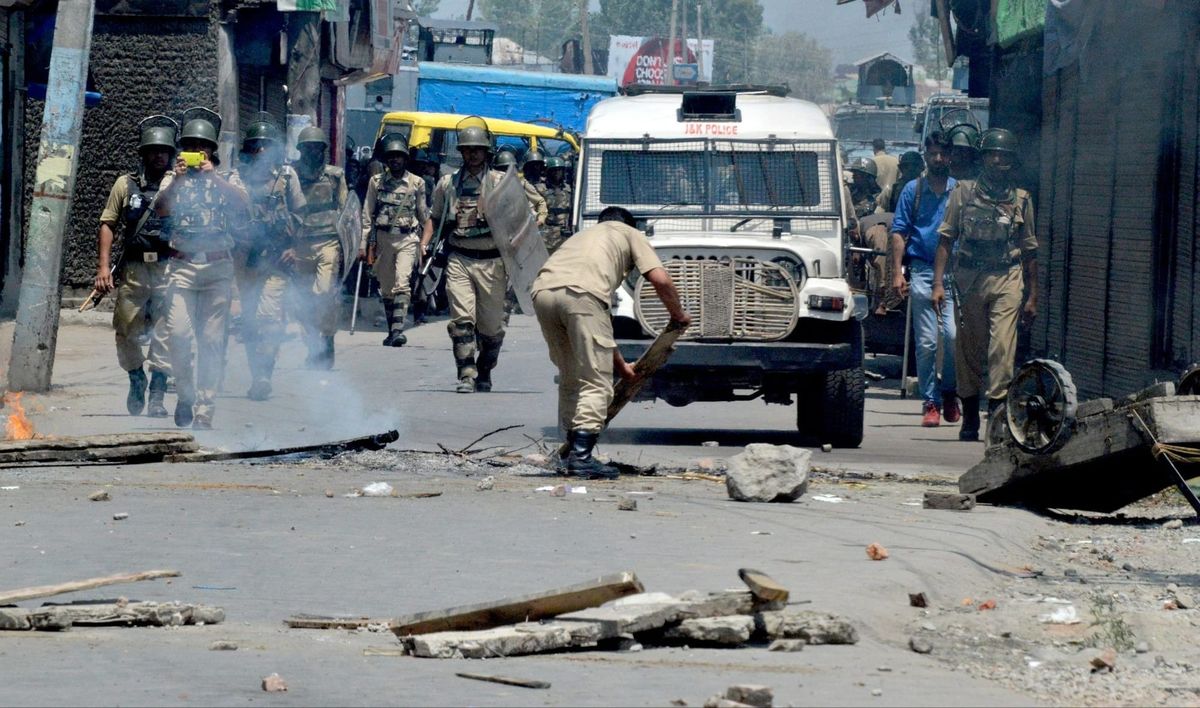
Pellets in India were first used in Indian-administered Jammu and Kashmir, where the debate over their legitimacy is anything but new.
Pellet guns were introduced in the Himalayan Valley in 2010, after street protests left around 100 civilians dead.
Security forces needed an alternative to live ammunition. The pump-action shotguns, which fire hundreds of small lead projectiles from a single cartridge, were presented as a “non-lethal” crowd-control option.
On August 30, 2010, 13-year-old Irshad Ahmad Parray, a seventh-grade student from Anantnag, 57 kilometres from Srinagar, was struck by pellets fired during street protests.
According to local media reports, pellets had penetrated his abdomen, chest and arms. He was taken to hospital but died on the way.
Parray’s death was an early warning of the flaw that would haunt pellet guns for years: the tragic gap between being labelled “non-lethal” and being capable of killing.
A study by doctors at Sher-i-Kashmir Institute of Medical Sciences in Srinagar later documented the scale of the injuries.
Researchers examined 198 patients treated for pellet-gun wounds during the 2010 unrest. Six died. Of the 80 patients who required hospital admission, 43 underwent surgery.
The injuries went far beyond superficial wounds.
Doctors recorded damage to the abdomen, chest, blood vessels, neck and eyes. Seven of 11 patients with eye injuries required surgery. Five were blinded in the injured eye, while one patient struck in both eyes became completely blind.
The youngest patient in the study was six years old.
Medical researchers have cautioned against treating pellet strikes as surface injuries.
“While the pellet wound itself may seem trivial,” they warned, “the failure to appreciate its potential to cause tissue disruption and injuries to the head, chest, and abdomen can result in catastrophic outcomes.”
They recommended that patients with pellet wounds be evaluated and treated in the same way as those sustaining bullet injuries.
The researchers also directly challenged the assumption behind the weapon’s introduction.
“Pellet gun (pump-action shotgun), though considered as a new benign modality (non-lethal weapon) for controlling agitated crowds, is not really benign,” they explained. “It can cause serious injuries with morbidity and mortality.”
They recommended that pellet guns either not be used against agitated crowds except when “extremely necessary”, or that personnel using them be better trained to prevent close-range hits.
Parray’s death, however, did not lead to the abandonment of the weapon.
Instead, pellet guns became a common method in India’s crowd-control strategy in Kashmir.
According to a 34-year-old constable in the Jammu and Kashmir Armed Police, the weapons are standard 12-gauge pump-action shotguns. Originally designed for hunting, they were repurposed for crowd control because a single cartridge releases hundreds of lead pellets in one burst.
“In Kashmir, the forces primarily used No. 6 and No. 9 cartridges,” the constable explained while speaking to Dunia. A No. 6 shell packs roughly 300 pellets measuring 2.79 mm across, while a No. 9 cartridge holds about 600 smaller pellets measuring 2.30 mm each.
Once fired, the pellets do not travel as a unified projectile. Instead, the pellets spray outward in a widening cone, making precise targeting impossible and ensuring that anyone within the blast radius, whether a protester or a bystander, is sprayed with lead.
That is also the source of one of the weapon’s main problems.
Official instructions require security personnel to fire from a distance of more than 50 feet and aim at the lower part of the body. At closer range, pellets have less time to disperse and can travel as a concentrated mass at high velocity, penetrating tissue and damaging bone and internal organs.
But the medical record from Kashmir showed that pellets did not reliably remain below the waist.
The weapon was used on a much larger scale in 2016, after the killing of Hizbul Mujahideen militant commander Burhan Wani.
The resulting protests and clashes filled Srinagar hospitals with victims suffering pellet injuries. Many had damaged or ruptured eyeballs.
By 2018, then Chief Minister Mehbooba Mufti told the Jammu and Kashmir Assembly that more than 6,000 people had been injured by pellet guns between July 8, 2016 and February 27, 2017.
Of these, 728 had suffered injuries to their eyes and at least 54 had impaired vision. Rights groups and organised groups of pellet victims put the number of people blinded much higher, between 100 and 350.
Official figures presented in Indian Parliament recorded 17 civilian deaths from pellet injuries between July 2016 and August 2017.
Amnesty International described the situation as a “mass blinding crisis.”
Among those injured was Insha Mushtaq, who was 14 when she lost her eyesight.
On July 11, 2016, three days after Wani was killed, Insha opened a window of her home in southern Kashmir’s Shopian, also known as the “apple town” of Kashmir, as protests raged outside.
A volley of pellets fired by security personnel struck her.
Mushtaq underwent multiple surgeries, but her eyesight could not be restored.
In the adjoining Rohmoo village of Pulwama district, life changed for Muhammad Ashraf Wani on a single day in 2016. The 38-year-old father of two was caught in a pellet gun attack that drove 650 pellets into his body. He would go on to undergo nine surgeries. One eye lost its sight entirely; the other retains just 30% vision.
“I am not able to do anything. I die a hundred times a day,” Wani told Dunia. "A bullet is better than pellets, a bullet kills you once, but pellets kill you every day.”
In November 2018, 18-month-old Hiba Jan became the youngest recorded victim of the pump-action shotgun in Shopian's Kapran village. She was inside her home, cradled in the arms of her mother, Marsala, when a cloud of tear gas fired at protesters outside seeped through the windows, making the air indoors unbreathable.
A single lead projectile struck the infant directly in her right eye, perforating the cornea and embedding itself deep near parts critical for vision.
The psychological consequences of pellet injuries were documented in a 2018 study by Government Medical College, Srinagar.
The researchers examined 380 pellet victims. Of these, 219 had simple injuries while 161 had grievous injuries, including loss of eyes, fractures and disfigurement.
Eye injuries accounted for 260 cases.
Among pellet victims with eye injuries, 30 percent reported depression, 17 percent had adjustment disorder, 13 percent suffered panic disorder and 11 percent had post-traumatic stress disorder.
Among the 161 people with grievous injuries, depression was the most common psychiatric condition, affecting 65 people, followed by PTSD, adjustment disorder and panic disorder.
The victims were overwhelmingly young. More than 40 percent were aged between 10 and 20, while another 41 percent were between 21 and 30.
The study showed that the impact of the weapon did not end when the wounds healed. For many survivors, the psychological consequences continued years later.
A 2022 study published in the Indian Journal of Ophthalmology examined eye injuries among pellet victims from the 2010 Kashmir unrest.
It found that 30 percent of pellet victims reported eye injuries and 50 percent suffered open-globe injuries.
Because of their high speed and small size, the study said, pellets can cause penetrating or perforating injuries to the eyeball or leave foreign bodies inside or around the eye.
CT scans of the orbit were performed in 662 patients, or 85 percent of those examined.
An intraorbital foreign body was detected in 415 patients, while 180 had an intraocular foreign body. Another 204 patients had vitreous haemorrhage.
The evidence made one point difficult to ignore: the principal danger of pellet guns is not only that they can kill but that they permanently change the lives of people who survive.
India restricted pellet guns, but did not ban them. The scale of injuries led the Union Home Ministry to establish a seven-member expert committee in 2016 to review the use of pellet guns.
The committee did not recommend an outright ban.
Instead, it said pellet guns should be used only in “exceptional, rarest-of-rare situations”, particularly when rioters became violent, posed a threat to life or endangered public safety installations.
Pellet guns were not supposed to be a routine response to civilian protest. Yet their use had already produced thousands of injuries.
Over the years, efforts were made to modify the weapons. Engineers developed muzzle deflectors to direct pellets toward a protester's lower body, alongside muzzle adaptors that allowed pump-action shotguns to fire PAVA irritant shells. The historic Rifle Factory Ishapore in West Bengal, a key state-owned defence unit established in 1904, even designed a reflector intended to concentrate the spray onto a specific target rather than letting it disperse widely.
Yet these technical adjustments failed to fix the weapon's inherent flaw. A single trigger pull still unleashes hundreds of independent lead projectiles, making the final point of impact impossible to control.
Former Intelligence Bureau special director and Indian Police Service (IPS) officer Yashovardhan Azad, who has filed a petition in the Supreme Court seeking a ban on pump-action guns, argues that this makes the weapon inherently unsuitable for civilian crowds.
“You can control the trigger but not the outcome,” he said. The pellets travel “in a conical form of a cloudburst of metallic shrapnel, which can hit any part of the body.”
“Even if you are using a rubber bullet, you can aim at the leg so that it is less harmful. But you cannot control a pellet gun,” he said.
In 2017, the Jammu and Kashmir government announced jobs for people blinded by pellets. A year later, the government told the Assembly that only 13 pellet victims had received jobs on compassionate grounds and 22 had received financial assistance.
Survivors eventually organised themselves.
In 2017, driven by the desperation Wani witnessed among victims, many of whom were poor and struggling with suicidal thoughts, he founded the Pellet Victims Welfare Trust. The organisation registered around 1,600 pellet victims and aimed to provide education and medical relief to survivors while campaigning on social media and organising protests to demand a total ban on pellet guns in India.
Though the Trust initially received strong support, assistance has waned over time. By 2024, the trust had raised only INR 900,000 (about USD 10,000), which was distributed among victims. Ninety-two people registered with the trust had lost vision in both eyes, Wani said.
The campaign eventually faded.
“The trust has been dysfunctional since 2024,” Wani said. “We were being summoned by different agencies for no reason. Eventually, we gave up on it.”
The campaign against pellet guns also reached the courts.
Advocate Aamir Ahmad Bandh, president of the Association of Pellet Survivors, told Dunia the J&K High Court Bar Association filed a public interest litigation in 2017 seeking a ban on pellet guns. The survivors’ association later submitted an intervention application, arguing that the weapon could cause lethal injuries. The proceedings were subsequently affected by the abrogation of Article 370 in 2019 and the Covid-19 pandemic.
“We argued that pellets are lethal and submitted an intervention application seeking a ban. But Article 370 and later Covid-19 disrupted the proceedings,” said Bandh, who was himself a pellet victim in 2017 and lost the use of one eye.
In December 2021, the Jammu and Kashmir and Ladakh High Court dismissed a public interest litigation seeking a ban, saying it was “not inclined to prohibit the use of pellet guns.”
The weapon therefore remained part of India's crowd-control arsenal.
Following the July 20 Delhi protest, Azad and others filed a petition in the Supreme Court seeking a ban on pump-action guns, including pump-action shotguns loaded wholly or partly with metallic pellets, for dispersing civilian assemblies.
On July 30, the apex court dismissed the petition, saying the use of pellet guns by police in “exceptional circumstances” was part of a graded approach to dispersing civilian protests.
Azad argues that India already has alternatives.
“These multiple-projectile systems are not used in any developed democracy,” he said. “We should stop their use completely because we already have an array of non-lethal crowd-control measures.”
Former Jammu and Kashmir Director General of Police S.P. Vaid told Dunia that the recent Supreme Court ruling makes clear that the police can use pellet guns in exceptional circumstances. But he said this did not mean they should be used in a way that risks blinding or killing people. “Security forces and police need to be properly trained in their professional use because once pellets are fired, they spread like a volley and can hit any part of the body, and sometimes kill a person,” he explained.
He also called for regular crowd-control training and mock drills, and said pellet guns should not be fired from less than 50 feet. “Other alternatives should be explored, such as rubber bullets and chilli powder.”
Reporting Irfan Amin Malik
Irfan Amin Malik is a journalist based in Indian-administered Kashmir.
Editing Seulki Lee (DUNIA Editor-in-Chief, Journalist) – skidolma@thedunia.org