No End by November: How Pakistan and India See the Iran War
By Seulki Lee (DUNIA Editor-in-Chief, Journalist)
SEOUL — The Iran War, which broke out on February 28, 2026, following the joint U.S.-Israeli airstrikes, shows little sign of abating as of September 13, 2026, and is instead escalating into a broader conflict.(Related story: Troubling Rhetoric Justifying Strikes on Afghanistan and Iran)
Direct military strikes between the United States and Iran continue unabated, accompanied by severe maritime navigation restrictions in the Strait of Hormuz and the Bab-el-Mandeb Strait, as well as recurring logistics disruptions across the Red Sea.
Major South Asian news outlets in Pakistan and India, along with the recent BRICS Summit hosted by New Delhi, have expressed grave concern over the alarming trajectory of the West Asian crisis.
Amid this regional escalation, South Korea is facing mounting pressure from U.S. President Donald Trump to commit military forces.
The administration of South Korean President Lee Jae-myung is reportedly evaluating a comprehensive range of deployment options to the Strait of Hormuz, including combat, non-combat, and search-and-rescue operations.
Meanwhile, South Korean civil society groups have voiced fierce opposition through street demonstrations, citing Article 5 of the Republic of Korea Constitution, which commits the nation to maintaining international peace and renouncing aggressive war.
Trump's "November Timetable" Under Scrutiny in Islamabad and New Delhi
In an editorial published on September 13, Pakistan's leading English-language daily, Dawn, analyzed that while President Trump asserts the conflict will wane immediately following the U.S. midterm elections in November, ground realities directly contradict such optimism.
Dawn noted that a war cannot be terminated at the press of a button, characterizing Washington's assumption that it can simply wait until November as a dangerous illusion.
On the ground, the fragile truce between Saudi Arabia and Houthi rebels has collapsed, putting the Bab-el-Mandeb Strait back under direct threat. Furthermore, attacks originating from Iraq have struck Saudi Arabia's East-West crude oil pipeline.
In Lebanon, relentless Israeli strikes have left thousands dead and hundreds of thousands displaced, triggering a domino effect of escalation across multiple fronts.
In light of these developments, Dawn urged Washington to take proactive confidence-building measures such as lifting blockades on Iranian ports and to immediately reopen diplomatic channels through regional third parties like Pakistan.
Concurrently, India's premier English daily, The Hindu, warned in a September 10 editorial that the war has entered a far more perilous phase.
Following U.S. strikes on five Iranian oil tankers in the Gulf, Tehran retaliated forcefully by launching ballistic missiles at a U.S. air base in Jordan and establishing a restricted zone in the Strait of Hormuz.
While Washington continues its "maximum pressure" campaign combining military strikes and economic blockades, Iran has responded by targeting U.S. naval vessels and rebuilding its offensive capabilities.
As a result, critical energy transit choke points in both the Strait of Hormuz and the Red Sea remain compromised, placing global supply chains linking Europe and Asia, as well as the broader global economy, under catastrophic strain.
The New Delhi Declaration: Gaza, Palestinian Statehood, and Mediation
Amid escalating military and economic friction, leaders of 11 member nations formally adopted the "New Delhi Declaration" on September 12 during the 18th BRICS Summit, chaired by Indian Prime Minister Narendra Modi.
According to the declaration statement, BRICS member states expressed deep concern over rising West Asian hostilities, demanding "maximum restraint" from all involved parties, the protection of civilians and critical infrastructure, and the unhindered flow of international trade and energy supply chains under international law.
Notably, the declaration devoted eight paragraphs to sharply criticizing Israeli military operations and forced displacement in the Gaza Strip, while endorsing South Africa's case at the International Court of Justice (ICJ) and reaffirming support for an independent Palestinian state based on 1967 borders.
The adoption of the declaration followed intense diplomatic maneuvering behind the scenes to bridge a divide between Iran and the United Arab Emirates (UAE).
As reported by Suhasini Haidar, diplomatic editor at The Hindu, initial ministerial talks had stalled. Tehran insisted on explicit condemnation of U.S. and Israeli aggression and targeted assassinations, whereas Abu Dhabi demanded an equivalent condemnation of Iranian strikes against neighboring Gulf states.
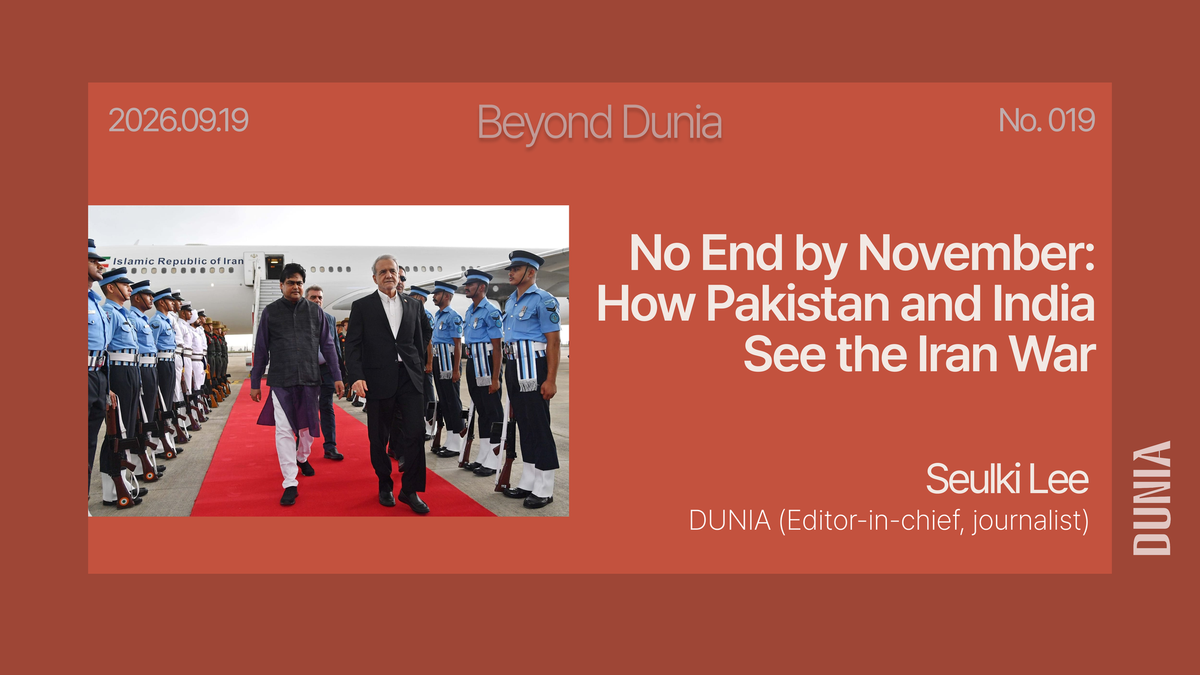
A breakthrough was reached at the Bharat Mandapam Convention Centre in New Delhi when a direct bilateral meeting was arranged between Iranian President Masoud Pezeshkian and UAE Crown Prince Khaled.
Both nations ultimately stepped back from their maximalist positions, agreeing to broader language urging "maximum restraint" and a "diplomatic solution" without explicitly singling out specific military actions by either camp.
Commenting on the diplomatic outcome, Professor Atul Mishra of International Relations at Shiv Nadar University told the New Delhi-based Asian independent media network Asian Dispatch that "the success of the Delhi summit will serve as a clear signal that Asia's future lies in economic development, not military hostilities."
Reporting Seulki Lee (DUNIA Editor-in-Chief, Journalist) – skidolma@thedunia.org
**Photo Credit: Ministry of Foreign Affairs, Government of India