Gold, Trucks, and Livestock: Kashmir’s Eid Donations for Iran
By Kamran Yousuf
The boy stepped forward in Srinagar as Eid prayers ended. He held a gold chain in his open palm. “This is for Allah, and for Iran,” he said. The volunteers took it, and the boy walked away in silence.
Some hours later, a widow stood before a crowd in another part of the city. She unclasped a piece of gold she had guarded for twenty-eight years. It belonged to her late husband.
“This is his memory,” she said. “I want it to go to Iran.”
The people around her fell silent, as she handed it over and left.
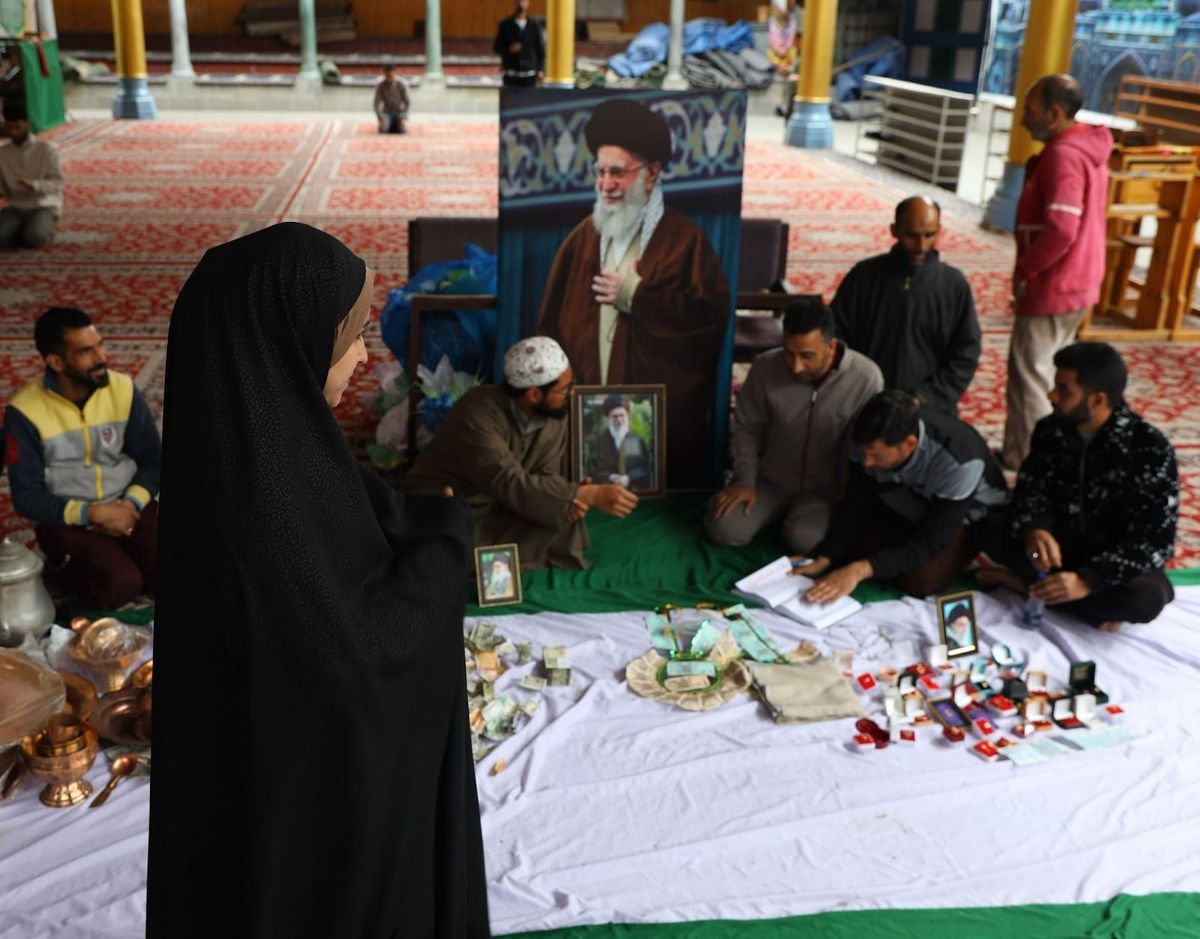
These scenes repeated across Kashmir throughout Eid. Donation camps appeared in Srinagar, Budgam, and surrounding districts. People arrived with objects they treasured, gave them away, and departed with a collective sense of solidarity.
A teenager rode his motorbike into a city camp and surrendered the keys. He refused to give his name. A man drove up in a small truck, his only source of income, and signed over the title. Women arrived straight from their homes wearing the jewelry they intended to donate. Copper utensils arrived in bundles, while livestock stood tethered near the tents. Shopkeepers gave portions of their Eid earnings.
The money and goods were intended for war-torn Tehran. The Iranian embassy in India acknowledged the campaign and thanked Kashmiris for their support.
“Observers often describe Kashmir as a place defined by curbs and the erosion of civil liberties,” says Seerat Nisar, a Srinagar-based social activist. “The donation drives of this Eid reveal a population capable of directing its own political energy outward, toward causes it chooses, through methods it selects.”
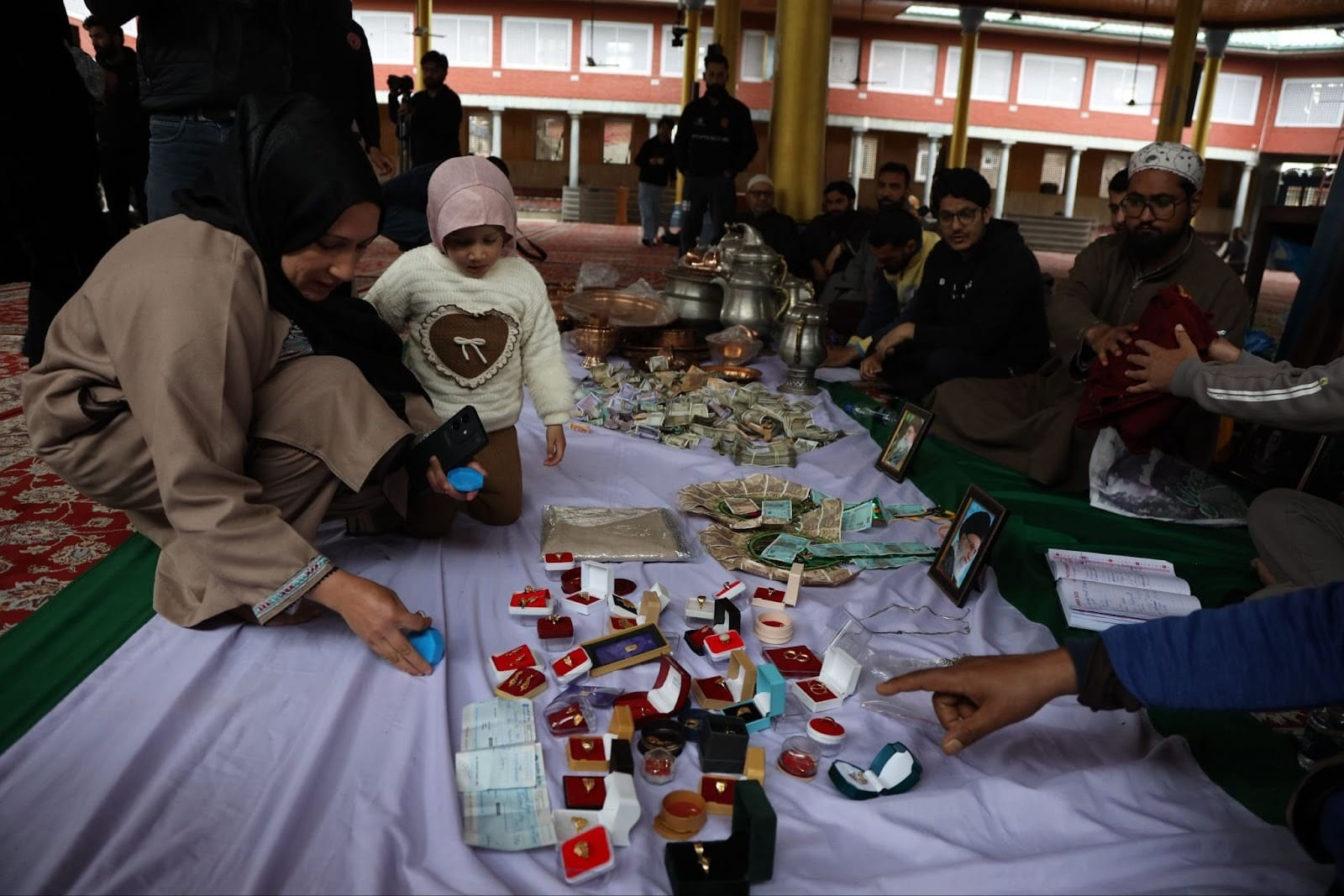
The scale of participation went beyond streets and sanctums. Budgam MLA Aga Muntazir Mehdi donated a month’s salary. Shia cleric Imran Raza Ansari used public meetings and social media to amplify the effort.
A trader in city centre Lal Chowk gave part of his income and noticed his neighbours doing the same. Shaiq Rasool, a banker, observed students, merchants, and families gathering in the same spaces. “The images circulated online and drew more participants,” Rasool said. “That visible generosity encouraged further participation and created collective momentum.”
This compassionate community campaign was driven by historical connection.
The bond between Kashmir and Iran stretches back centuries. Mir Sayyid Ali Hamadani, the Persian Sufi saint, visited Kashmir multiple times between 1372 and 1384. He brought scholars and artisans who transformed the region’s religious practice and craft traditions. His writings remain part of daily worship in Kashmiri homes. Shia Islam spread through subsequent contact with Persian religious figures.
Shias make up about 10-15 percent of Jammu and Kashmir’s population, roughly 1 to 1.5 million people, mainly in Budgam, Baramulla, and parts of Srinagar. Reporting from Srinagar and Budgam shows the donation drive went far beyond Shia networks. Sunni donors made up nearly half of participants in some camps, showing how people often set aside sectarian differences during religious or humanitarian efforts.
“Everyone felt the same,” a Sunni cleric observed, noting how the campaign brought people together beyond labels and tags. “The gifts crossed communal lines, but kept their religious meaning.”
The 1979 Iranian Revolution had earlier strengthened these community ties. Kashmiri institutions began sending students to Iran for religious training, and clerics built long-lasting connections with Iranian seminaries. Many families still maintain these links today.
“These networks work outside state control,” says Hamid Ali, a Shia cleric. “They offer ways for religious learning, cultural exchange, and solidarity that don’t rely on official structures.”
Rafiq Bhat, a Srinagar-based scholar, explained that Iran connects to faith and learning through channels that official diplomacy cannot replicate.
“Ayatollah Khamenei had spoken about Kashmir in the past, calling on Muslims to support the region,” Bhat says. “I followed those speeches for years. Hearing a foreign leader speak about Kashmir created a sense of closeness that endured.”
Khamenei visited Kashmir in the early 1980s, before he rose to national leadership in Iran, as part of a brief outreach tour following the 1979 Iranian Revolution.
During a roughly 48‑hour stay in Srinagar, he joined Friday prayers at the historic Jamia Masjid alongside then‑Mirwaiz Molvi Mohammad Farooq and delivered a short address that emphasized unity and engagement with both Shia and Sunni communities.
Eyewitnesses recall large crowds at the airport and visits to key religious sites such as the Hazratbal Shrine and Zadibal Imambara, and local accounts describe the visit as symbolically significant in the region’s sectarian history.
Days before 2026 Eid, thousands, including Sunnis, marched through Srinagar to protest Khamenei’s killing in the US-Israeli strike. They gathered at Lal Chowk and shouted slogans.
“People felt a connection and wanted to respond,” Bhat said. “Earlier, that response came through demonstrations, but now it took the form of giving.”
Opting to contribute rather than protest shows a measured approach, adjusting to the situation while keeping purpose intact.
Sadakat Ali Mir, who donated his truck, framed the decision as a family matter. “This is how I earn every day,” he said. “I discussed it with my family. Then I felt I should give it.” He added the Almighty takes care of sustenance.
Bilal Ghazi, who contributed his two-wheeler, described similar discussions at home. “We talked about it,” he said. “We felt this is something we can do.”
Both acts underline careful choices made within households, measured against practical needs and responsibilities.
Nusrat Bano, a donor from Chandpora Budgam, described the range of contributions in her village. People brought whatever they had: hens from coops, cows from sheds, and wedding gold from lockers.
She pointed to women who had come directly from their homes wearing items they intended to donate.
“The variety of gifts shows participation across economic lines,” Nusrat says. “People gave what mattered to them, turning charity into a political statement connected to shared religious and cultural ties.”
Volunteers said people gave by watching others and deciding for themselves, without anyone leading.
“This was charity,” explained one organizer, highlighting the decentralized nature of the mobilization, “but it also sent a message about where loyalties lie.”
By evening, the pattern of giving was visible in the crowd itself.
Sadakat Ali Mir stood apart, observing people arrive with contributions large and small. “People are giving what they can. That is what matters,” he said.
In small acts, Kashmiris demonstrated thoughtful coordination, turning personal choices into shared expression.
Reporting Kamran Yousuf
Kamran Yousuf is a multimedia journalist based in India with ten years of experience covering human rights, politics, environmental issues, gender, and technology. His reporting from across the country has appeared in several national and international media outlets. Instagram @Kamran_yousf