Kashmir’s VPN Ban: Security Over Livelihoods
Irfan Amin Malik
Srinagar: In the summer of 2017, amid routine internet shutdowns that cut Indian-administered Jammu and Kashmir off from the outside world, Waris Wani, a young man from south Kashmir’s Pulwama, once among the region’s most militancy affected areas, decided to become a YouTuber.
33-year-old Wani saw the digital space as a chance to build an income and share his comedy videos beyond the region. “I believed the internet could open doors for me in a place with limited job opportunities,” he told Dunia.
Building that future, however, meant working around internet shutdowns that had little to do with creativity. “You never knew if your video would go online or the network would go offline,” Wani recalled.
Locally known as “Waris Raj,” Wani is a resident of Pinglish village in Pulwama district. He runs “Funny Kashmir,” a Facebook page with more than 482,000 followers, and a YouTube channel with over 237,000 subscribers. Over time, some of his comedy videos went viral.
“Within a few years, I began creating videos that were widely appreciated,” he said. “But content creation came with many hardships. There were times when the internet was suspended for months, and that directly affected my reach and growth.”
Persistent Blackouts, Total VPN Blockade
According to data compiled by the Software Freedom Law Center, India, internet shutdowns in Kashmir rose sharply beginning in 2017, with 32 disruptions recorded that year and 52 in 2018. The number climbed further in 2019 to 55 shutdowns amid widespread security clampdowns following the abrogation of Article 370, the Himalayan region’s special status. Restrictions intensified in 2020, when the region recorded 115 shutdowns, the highest annual figure on record.
Large-scale blackouts gradually declined in subsequent years. But digital uncertainty did not completely disappear.
For online workers like Wani, a new disruption emerged.
In December last year, the Union Territory administration ordered a blanket ban on the use of Virtual Private Networks (VPNs), citing security concerns. For Wani and hundreds of other creators, the order was another turning point.
This time, the disruption struck at the core of production.
According to Wani, the VPN restrictions made it difficult to access tools many creators relied upon. Among them was CapCut, a widely used video-editing application known for its ease of use and professional-quality features.
“With CapCut, we could make videos look professional without expensive equipment,” he said.
In a region where many young creators cannot afford high-end devices or paid editing subscriptions, such applications lowered the barriers to entry. The app allowed users to produce polished videos using basic smartphones.
Since access became unreliable, Wani said the quality of his work has suffered.
“When the presentation drops, growth drops. And obviously my income has been affected too.”
On platforms where algorithms reward consistency and visual polish, even small disruptions can quickly translate into fewer views and declining earnings.
“After the VPN ban, my videos started losing their presentation, and naturally the reach and revenue followed,” Wani said. “Compared to the rest of the world, we are already working in tough conditions. Orders like the VPN ban break our backs. If this continues, we fear for our future.”
He added that some Indian creators have shifted operations to places like Dubai to avoid repeated disruptions.
“I may also have to relocate,” he said. “We need full internet access and freedom of expression.
The impact has not been limited to comedians.
Yasir Dar, a 30-year-old singer known for performing Kashmiri songs on social media, said the VPN restrictions have disrupted the tools he relies on to produce short-form videos and reels.
“Our livelihoods and responsibilities are directly dependent on secure VPN connectivity,” Dar told Dunia.
He recalled that the 2020 ban on TikTok had already shut down one of his primary income streams. “I had 85,000 followers on TikTok within a year,” he said. “When TikTok was banned, that revenue option was closed.”
The VPN restrictions, he said, have compounded that uncertainty. “Now the VPN ban has forced me to rethink working as a content creator in Kashmir.”
Dar said he had recently travelled to cities such as New Delhi, Mumbai and Chandigarh, where he was able to use CapCut without interruption. “I was using the app freely there for my work,” he said. “But while returning to the Valley, I uninstalled it out of fear of being stopped by police.”
For Dar, the decision was less about technology and more about anxiety. “You don’t know what could create trouble,” he said. “So you avoid it.”
A Digital Crisis: Influencers and Hidden Workers Face a Precarious Future
India’s influencer ecosystem has grown rapidly in recent years. For example, according to a report by influencer marketing intelligence platform Qoruz, the country’s influencer base has expanded fourfold since 2020, from fewer than one million creators to more than four million. Much of that growth has come from smaller cities and non-metro regions, including places like Kashmir.
Yet the restrictions in restive Valley have unsettled not only creators in front of cameras but also a less visible workforce operating behind screens.
Fayiq Ahmad, a 24-year-old computer science graduate from Lal Bazar in downtown Srinagar, works as a freelance web developer for global clients.
“Testing software or applications is the backbone of what we do,” he said.
When his team develops an app, Ahmad explained, they must simulate how it functions in different countries—across languages, servers and regulatory environments.
“That is only possible through VPNs,” he told Dunia. “We switch locations to see if the app behaves differently elsewhere. After the ban, that process has completely stopped.”
He described the effects as cumulative. Research tasks stall. Routing issues cannot be tested across regions. Cybersecurity preparations, including simulating bot attacks from foreign locations, become harder to execute.
“It’s not just about income,” Ahmad said. “Our productivity is down. Our capabilities are affected. In the long run, that will impact our earnings.”
Similarly, Imran Bashir, a 38-year-old software engineer working from his home in Kashmir for a US-based banking software company told Dunia that VPN access is central to remote corporate work.
“The use of VPN is mandatory for office connections within the organisation,” Bashir said. “It is strictly for secure access to company systems and has no role in anything else.”
A VPN allows users to route internet traffic through remote servers, masking their IP(internet protocol) address and enabling secure connections to corporate networks.
Since the ban, Bashir said, some employees have relocated to other Indian cities to continue working.
“If staff cannot use VPNs from Kashmir, companies may ask them to relocate,” he told Dunia. “A blanket ban can eventually lead to layoffs if employees are unable to move outside the region.”
According to Jammu and Kashmir police, more than 1,100 individuals were identified for allegedly circumventing VPN restrictions. Several were detained and booked.
The enforcement of the ban has also raised concerns about privacy.
Bilal Ahmad, whose name has been changed to protect his identity, is a resident of Shopian, the apple-growing town in south Kashmir. He said routine security checks have become more intrusive.
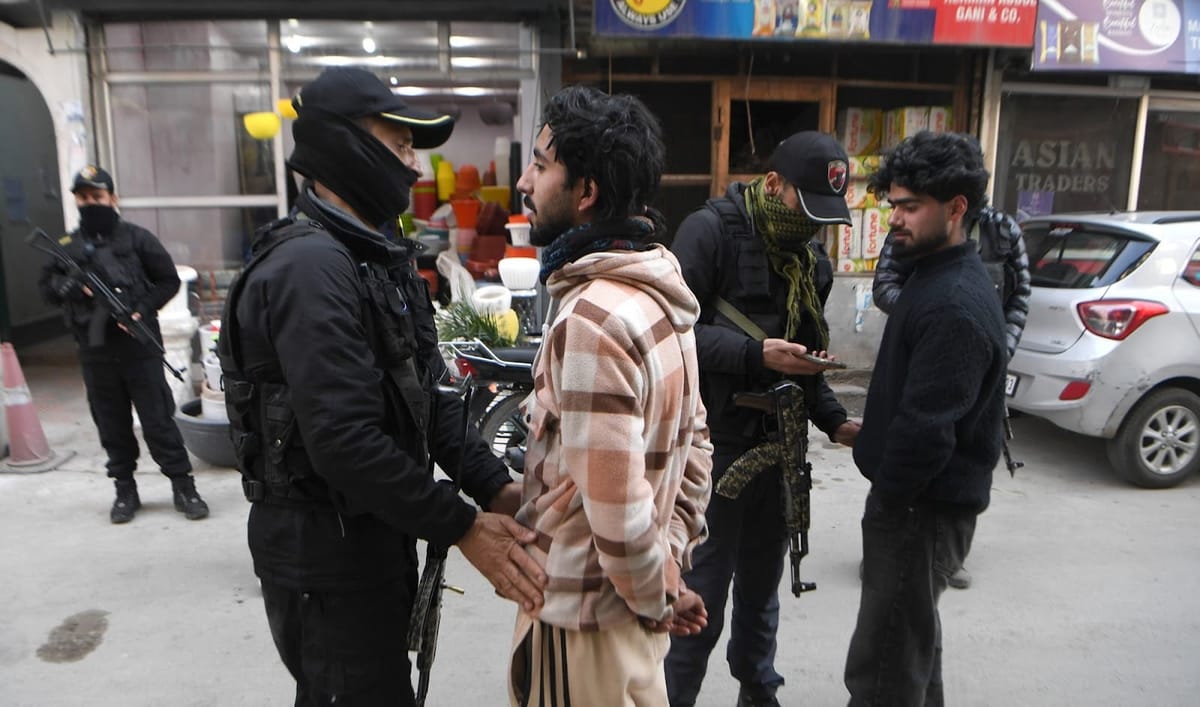
“On a recent winter morning, security personnel stopped me at a checkpoint and scrolled through my phone while looking for VPN applications,” he told Dunia. “They told me it was part of security measures. That may be understandable. But going through photos and personal messages is disturbing. This is not about security. It feels like an invasion of privacy.”
In India, VPN use is not illegal. They are widely used for secure browsing and access to geo-restricted services. However, in 2022, the government introduced regulations requiring VPN providers with physical servers in India to log and share certain user data. Several companies withdrew their physical infrastructure from the country.
Officials in Jammu and Kashmir said the recent restrictions were imposed under emergency powers to address specific security concerns.
A police spokesperson described the order as preventive. “Since the VPN service has been misused by terrorists and their supporters to disrupt peace in the region, the decision to ban VPNs is an important step to prevent untoward incidents,” the spokesperson said.
Security vs. Rights: A Shaky Future for Digital Kashmir
According to police, intelligence inputs suggested that militants and their supporters had used VPN services to remain in contact with handlers across the border in Pakistan. Officials said VPN services could mask locations and facilitate encrypted communication, making it harder to track suspected militant activity.
Digital professionals said they do not dismiss security concerns but question the breadth of the restrictions.
“Security concerns cannot be overlooked,” Ahmad said. “But a blanket ban affects everyone, including those contributing positively to the digital economy.”
He suggested a regulated framework such as whitelisting approved services that could preserve security objectives while allowing legitimate business operations.
“With dialogue between security authorities and the business community, we can maintain safety without shutting down VPNs completely,” he said.
Sundeep Narwani, an AI researcher based in New Delhi and co-founder of the Narrative Research Lab, said VPNs form part of the basic infrastructure of digital work.
“They are used for testing applications across geographies and accessing global tools,” he said. “When access becomes uncertain, productivity and client confidence suffer.”
India’s technology sector remains largely service-driven, he noted, making uninterrupted connectivity essential. In regions such as Kashmir, where digital work has become an alternative to limited local employment, broad restrictions carry deeper consequences.
“Countries such as the US, Israel and China invest heavily in strengthening their technology ecosystems,” Narwani told Dunia. “If we want to prevent brain drain and build product-based companies, the government needs to support the online workforce.”
Irfan Amin Malik is a journalist based in Indian-administered Kashmir.