Erasing the Tragedy, Chasing the Stock Market: An Unpacking of the "Pro-Superpower" Bias in South Korean Media’s Coverage of the Iran War
By Seulki Lee (DUNIA Editor-in-Chief, Journalist) – skidolma@thedunia.org
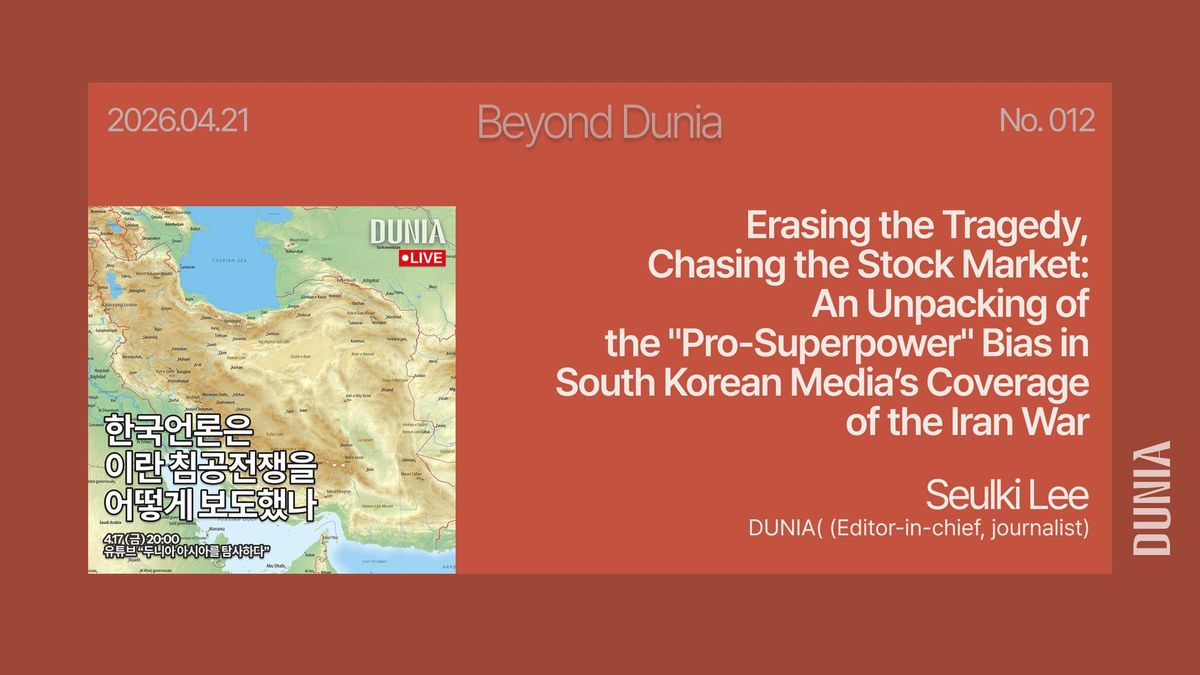
As the war triggered by the U.S. and Israeli invasion of Iran enters its 48th day amid talks of ceasefire and peace agreements, Dunia, a non-profit independent media outlet specializing in Asian affairs, hosted a live panel discussion dissecting South Korean media's coverage over the past six weeks. Hosted by Dunia reporter Seulki Lee, the panel featured international conflict reporter Yukyung Lee, Yeri Kim from Media Today, and Chaerin Park from News Where, who intensely criticized the structural blind spots and biases in Korea's international journalism.
According to the experts and journalists, South Korean media coverage of the Middle Eastern war closely resembled propaganda. It erased the horrific realities of the war, uncritically accepted the logic of superpowers, and consumed the tragedies of other nations merely as economic tools.
Eyes on 'Stock Returns' Instead of Bombed Elementary Schools: The Disappearance of Humanitarianism
The panelists expressed immense frustration over the complete evaporation of the humanitarian perspective, which should be the core of war reporting. Despite clear violations of international law, such as the bombing of the Minab Elementary School in Iran on the first day of the invasion which resulted in 170 casualties and the "double-tap" bombings of medical staff and civilians in Lebanon, the Korean media paid little attention to these tragedies.
Reporter Yukyung Lee cited the assassination bombing of Iranian nuclear scientist Saeed Samaghadri as a prime example of the media's insensitivity. Because airstrikes cannot target with absolute precision, dropping a bomb on a residential area inevitably turns the surroundings into a devastated war crime scene with dozens or hundreds of civilian casualties. Yet, the media merely treated it as a simple straight-news announcement of "an assassination" by the perpetrators, failing to question or uncover the true face of the violence.
Instead, the Korean media's attention was squarely fixed on the stock market. Reporter Yeri Kim pointed out that economic newspapers churned out daily articles about retail investors "laughing and crying" as they invested in "Gotbus" (inverse ETF) funds, betting on stock market declines caused by the war. During the early stages of the war, articles worrying about the stock market impact were 2.2 times more frequent than reports on the bombing incidents. The media reduced the tragedy of ordinary citizens dying to a matter of profit generation and discussions on "beneficiaries of K-defense stocks".
A Hollywood Movie Adaptation of Tragedy: Blatant "Identification with the Strong" and Double Standards
The media's serious double standards and bias toward the strong, uncritically accepting the perspectives of the invading nations (the U.S. and Israel), were also heavily scrutinized. Reporter Chaerin Park mentioned a front-page article in the Chosun Ilbo about the rescue of a downed U.S. fighter pilot. Instead of covering the war's devastation, the media overly sympathized with the U.S. military, framing the event like a Hollywood movie script titled "A 36-Hour Struggle: Saving Another Private Ryan". Furthermore, a reporter's column arguing that "the U.S. can do that, and it's okay" was cited as the worst example of the Korean media's blatant stance of tolerating an illegal invasion.
Conversely, an unhinged demonization and negative framing operated against the attacked nation, Iran. The media elevated the deployed U.S. troops with their official title, "the elite 82nd Airborne Division," while describing the Iranian military as "killing machines". Furthermore, some outlets like JTBC definitively reported without any evidence that Iranian militias were deployed to use "civilian human shields," rushing to impose the image of an abnormal terrorist state.
Within this biased framework, the media abandoned the journalistic basics of uncovering the essence of the war and verifying its justifications. They competitively transcribed the false pretexts and nuclear threat claims put forward by former U.S. President Trump and Israeli Prime Minister Netanyahu as breaking news. Although Iran is a signatory to the Non-Proliferation Treaty (NPT) and allows international inspections, Korean media cited foreign reports to broadcast subtitles claiming Iran could "build a nuclear bomb within 3 months," uncritically stirring up fear. In a contradictory move, they remained silent about Israel, which is not an NPT member, possesses nuclear weapons, and refuses international inspections.
Blind Spots of the Correspondent System and Blind Obedience to Mainstream Anglo-American Media
The lack of on-the-ground reporting and an extreme dependence on Western foreign media were also brought to the chopping block. Reporter Yukyung Lee criticized Korean correspondents for staying in Oman — the most peaceful country in the Middle East — broadcasting with a quiet background, or relying on articles written in Washington and L.A., rather than going to the actual sites of the conflict, such as Lebanon, which is not impossible to enter.
If reporters cannot go to the scene, they should at least make an effort to secure reliable sources, but this too was replaced by transcribing specific Western media. According to an analysis by Pressian, during the war, Korean media cited Reuters 1,290 times and the New York Times 1,000 times, while Al Jazeera — a Middle Eastern media outlet reporting the actual horrors on the ground in real-time — was cited a mere 120 times. The panelists criticized the "pathetic practice" where excellent independent local media like Middle East Eye are the first to report the truth of the tragedies (such as double-tap attacks), but Korean media only report it under the borrowed names of Anglo-American outlets after The Guardian or CNN transcribe it. Even as trust declines and boycott movements arise within the Anglo-American sphere against their own mainstream media for erasing massacres in places like Gaza, Korean media continue to cling blindly to the authority of these corporate giants.
Distorted Iranian Public Opinion and Unfiltered "Expert" Fallacies
Severe distortion also occurred as domestic media conveyed Iranian public opinion. Using the excuse of internet blackouts in Iran, the media ignored the voices of balanced local scholars (like Professor Siyavash Safari) who criticize both the oppressive Islamic regime and the illegal foreign invasion.
Instead, through major YouTube channels (like 3Pro TV), radio shows, and conservative media (Chosun Ilbo), they massively amplified the claims of specific royalist diasporas, such as a former "Miss Iran," who advocate for the return of the corrupt and oppressive Pahlavi dynasty and welcome foreign intervention, presenting them as the universal representatives of the Iranian people. These figures even condemned opposition leader Lee Jae-myung's humanitarian aid plans as "cheering for terrorism," a claim the media broadcasted unfiltered. Despite independent polls showing that Middle Easterners overwhelmingly consider Israel and the U.S. — not Iran — as the top threats, the media selectively chose speakers who perfectly aligned with a pro-U.S. and pro-Israel framework.
The bias and errors of so-called "expert panels" appearing on broadcasts were also heavily criticized. Some experts obfuscated the essence of a clear illegal invasion by framing it with a "religious conflict" false equivalence, stating that "both Islamic and Jewish fundamentalism must be laid down". Furthermore, they turned a blind eye to Israel's massacres of civilians — the root cause of the war — while blaming Iran by saying "Iran's demands are too strong". They also amplified anxiety by grouping Iran with North Korea, thereby spreading unfiltered errors that blind the viewers.
The Limits of "Foreign Press Translation Departments" Driven by Clicks
The panelists identified the fundamental cause of this recurring reporting behavior as the outdated perception of the Korean media, which treats international news as "someone else's business" and relegates it to the back pages. This is the result of a combination of factors: international departments that rotate staff every year leading to poor expertise, and an environment that highlights only the provocative words of politicians and clickbait thumbnails (e.g., explosions, shaded faces of leaders) to drive YouTube views and portal clicks.
In conclusion, if South Korea's international desk reporters continue to neglect in-depth context reporting and the building of local networks, settling only for translating biased foreign press, they will not be able to avoid the harsh forecast that "international desk reporters will be the fastest to be replaced by AI". The panelists unanimously urged readers and viewers to boycott news with biased frames using a critical eye, and to strongly demand that the media provide coverage based on human rights and the universal values of global citizens.
Reporting Seulki Lee (DUNIA Editor-in-Chief, Journalist) – skidolma@thedunia.org