Fewer Numbers, Same Violence: Five Years of Myanmar's Coup in Data
By Seulki Lee (DUNIA Editor-in-Chief, Journalist) – skidolma@thedunia.org
Since the coup of February 1, 2021, more than 100,000 people have been killed in Myanmar. Street protests,, gave way to armed resistance after being crushed. The military responded with airstrikes, arson and arrests. Even after Min Aung Hlaing moved from commander-in-chief to civilian president in April 2026, the violence did not stop. As fighter jets in formation repeatedly bombed single targets and people were taken away over a single online post,. Fewer incidents are being recorded, but the violence has only changed shape.
One person records these numbers every week. Lee Han-gyu is a research manager at ACLED (Armed Conflict Location & Event Data), an international conflict data organization, where he oversees conflict and protest data for eight countries in East and Southeast Asia, including Myanmar. We asked how someone who studied journalism and international studies and published essay collections came to enter the cold world of quantitative data. We also asked about ACLED’s collection method, in which researchers with local knowledge, and how to read the “silence of data” in countries where reporting is blocked, such as China, North Korea, Laos and Vietnam. He also spoke about his life: setting aside emotion and staying value-neutral when coding, while continuing civic engagement outside work through activism with People’s Solidarity for Participatory Democracy (PSPD), support for a migrant center, and running a co-living house. He reflected, too, on the “double globalization” in how Korean society views Southeast Asia.
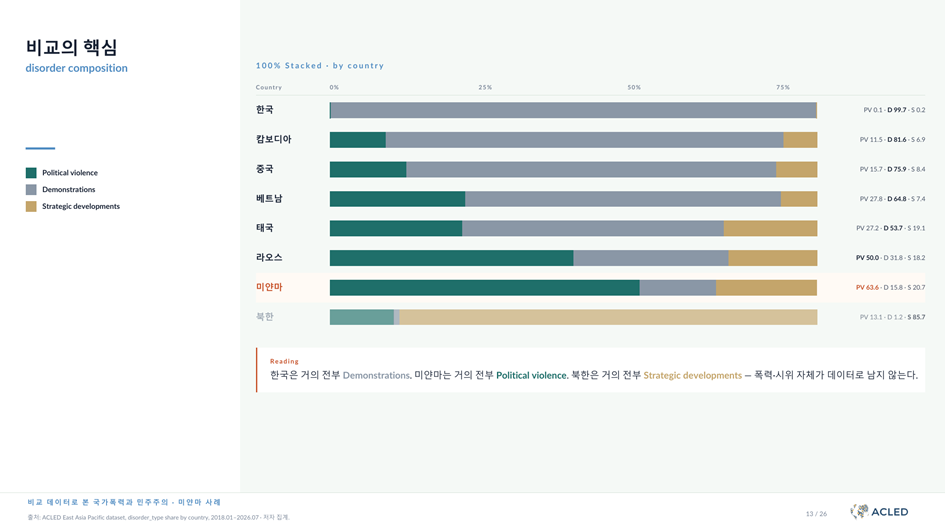
The interview with Dunia took place in Seoul on August 28. To aid readers’ understanding, this article includes figures and charts from his presentation, Comparative Data on State Violence and Democracy: The Case of Myanmar — Reading Seven Asian Countries Through ACLED Data. He gave it at the seminar “State Violence and Democratic Solidarity in Asia,” hosted by reSEArcher, a network of Southeast Asia regional researchers.
The following is Dunia’s Q&A with him.
- Please introduce yourself to Dunia’s readers.
=I’m currently the research manager for East & Southeast Asia at ACLED. I oversee the weekly coding and review of conflict, protest and strategic development events in eight countries: South Korea, North Korea, China, Myanmar, Cambodia, Vietnam, Laos and Thailand. This is my sixth year with the organization. I first joined as the researcher in charge of Korea data, thanks to my master’s thesis on the impact of YouTube on political polarization in Korea. When I started, I worked to understand the complex contexts of protest actors on both the progressive and conservative sides. These ranged from labor groups like the Korean Confederation of Trade Unions and the Federation of Korean Trade Unions to Pastor Jeon Kwang-hoon’s followers and the Korea Kindergarten Association. Later I took on Southeast Asia, and now I cover Southeast Asia together with South and North Korea.
As an undergraduate I majored in journalism (Communication & Culture). For my master’s in Global Studies, I spent two semesters in Germany (University of Freiburg) and one semester each in Argentina (FLACSO) and India. My classmates all chose different thesis topics. A Filipino friend studied the lives of widows from the Duterte government’s “war on drugs,” and an Egyptian friend researched graffiti that challenged the military. After studying international affairs, everyone ended up writing about their own country. I realized that what you look back on, in the end, is yourself. I’ve also kept up personal writing, publishing three books, including travel essays and an interview collection (One-Day Trip, Prague, Others 50). At work, to stay value-neutral, I “record the world in nouns and verbs.” Outside work, I try to find balance in my emotional life by “seeing the world in adjectives and adverbs.”
-You didn’t major in statistics or data. How did you get into conflict data?
=Until I finished my master’s, I was on the writing side, enough to publish two essay collections, and this job was my first experience with data analysis. I’d basically walked the opposite path. But the ACLED dataset is very different from other quantitative data. We look at partner datasets too, and some really are just numbers. Some organizations simply list events with a number for each type. ACLED, though, always writes a “Note Column” describing the specific circumstances and context of each event.
We collect quantitative data, but narrative and explanation of the situation are still necessary. That’s the point that suits me best. There are limits to seeing the world through numbers alone. Even if you don’t make value judgments directly, I think capturing all the concrete information ultimately requires qualitative information.
-How does ACLED collect and analyze conflict data?
=ACLED began when Clionadh Raleigh, a professor at the University of Sussex and now the CEO, built an African conflict dataset as her PhD research project. and grew into the leading global conflict data organization. Today it’s the largest dataset in the field and employs the most people.
Unlike other organizations that focus on machine learning or AI crawling, ACLED has human researchers who directly collect and verify information from more than 5,000 sources in over 75 languages. Sources differ by country. For Korea, we read everything from the Chosun Ilbo, JoongAng Ilbo and Dong-A Ilbo to OhmyNews, regardless of conservative or progressive leaning. For Myanmar, we read Eleven Media, which is under the military’s influence, as well as Khit Thit Media on the opposite side. Including information from local partnerships, we gather as many diverse voices as possible.
The UN is the largest funding pillar. Crisis-related funding made up about half, and one of those funds, as disclosed on our website, is the UN-run Complex Risk Analytics Fund (CRAF’d). There are also project-based grants from the European Parliament or European governments, for example for the Red Sea, Yemen and Palestine. Until recently, funding was concentrated in the humanitarian field, but that’s changing a lot now.
The organization’s motto is “Bring Clarity to Crisis.” During the recent Thailand–Cambodia border conflict, there was so much information that it was hard to see at a glance where and how many people had died, or how the conflict started and escalated. Our dataset filters all of that, item by item, and organizes it as conservatively as possible. That’s probably why Western media use our data so much for Myanmar, Palestine and Ukraine. In 2023 alone, we recorded more than 326,000 events, with 35,000 media and academic citations and 14,000 downloads. I think that was possible because we bring scattered, massive amounts of information together into a single dataset.
According to his presentation, ACLED builds its data by translating academic definitions into measurable event types. For state violence, it draws on DeMeritt’s (2016) concept of “physical violence with a political purpose” and Davenport’s (2007) definition: “state actions that seek to control the beliefs and behavior of individuals or groups through actual or threatened sanctions.” Events are divided into six top-level types — battles, explosions/remote violence, violence against civilians, protests, riots and strategic developments — and 25 sub-types, and no event is counted twice. For cross-country comparison, these are regrouped into three categories: political violence, protests and strategic developments. Strategic developments are events like looting, arrests, recruitment and territorial transfers, which are not violent but matter in a conflict context. An event in which the state used excessive force against nonviolent protesters is both a protest and state violence, but his analysis counted it as political violence.
- How do you interpret the “data gaps” and “silence of data” in countries with heavy media censorship and control (China, North Korea, Laos, Vietnam)?
=ACLED publishes each country’s data limitations and methodology in the Knowledge Base on its website, and uses different approaches for each country to fill data gaps. In Myanmar, we lowered the collection threshold for arrests from the usual 25 people to one. So even a single person being taken away is recorded as an act of political repression, because after the coup, arrests themselves often have a political purpose. Of course, if a source confirms it as a criminal case, we don’t code it. In China, the way people protest is different from the start. Koreans hold a lot of press conferences, but Chinese people go to petition. When such people are locked in unofficial detention facilities or disappear, we code it as “Abduction” under “violence against civilians.” North Korea has almost no material to begin with, so we code mainly events observable from outside, such as missile tests, rocket launches and unidentified projectiles, and we document exactly how we code them in the Knowledge Base.
We keep working to narrow those gaps, but there are limits. China has one of the largest gaps. Protest-related posts on Douyin or Weibo are often deleted within 24 to 48 hours. On top of that, we’re an armed conflict data organization, so our funders aren’t very interested in protest data, which creates budget problems too. So we look for partners. For Chinese protests, we’ve been in ongoing talks with the China Dissent Monitor, created by Freedom House. The problem is that their budget has also shrunk, since the Trump administration’s cuts or even before. They still collect data but can’t publish it.
- Coding seems to require a value-neutral approach and emotional restraint. What’s that like?
=Looking at Korean protest data, — the Sewol ferry, the Stellar Daisy, the humidifier disinfectant disaster — remain unresolved, so the same protests keep repeating. The organizers are always the same, too. If I project personal feelings onto the reality that their voices haven’t reached society, it becomes so sad that it’s hard to work. All the more so with Myanmar’s civil war, where more than 100 people die every week and the cumulative death toll approaches 100,000. Emotional restraint is essential.
Another concern is that I have political leanings too. I have personal opinions on human rights, labor conditions and women’s issues, so sometimes my subjectivity tries to show through when I write the Note Column. Restraining that is my biggest struggle. In the review process, we strictly neutralize language. For example, if a claim was made regarding Yoon Suk Yeol’s martial law or a sexual harassment case, it must be written as “alleged.” But sometimes a researcher already believes the person is guilty and writes it definitively. In those cases, I revise it as conservatively as possible. When local Myanmar researchers write “terrorists” for the military, I understand the feeling — for them, this is a struggle — but I change it to “Tatmadaw/Myanmar Military.” Terrorism has a definition in academia and in our methodology. When they call the resistance a “Revolutionary Force,” we revise it to “Anti-coup armed group.” Of course, if the People’s Defense Force (PDF) gave itself that name, we use it as is. Separatists in southern Thailand are labeled “MMS (Malay Muslim Separatists).” On the South China Sea and the Taiwan Strait, Chinese media write only briefly that they “patrolled,” while Taiwanese and Philippine media, who feel a real threat, write in detail from their own national perspective. We also keep those expressions as restrained as possible. If the value neutrality of terminology breaks down, the dataset’s consistency collapses.
Instead, I look for ways to contribute outside work. Looking at Korean data, PSPD shows up in almost every issue. When small civic groups find it hard to hold a press conference alone, they do it with PSPD. I thought this organization needs to exist, so I started donating in 2021, I’ve been active in Youth PSPD, and I’ve joined their protests. Even when I post on my personal social media, I make clear it has nothing to do with my organization’s position. I also subscribe to and support Frontier Myanmar. After the Myanmar coup, I began supporting the Suwon Migrant Center near Suwon Station and joined protests at the station. But I felt that wasn’t my place to stand, so I shifted to donating instead.
I actually prefer qualitative stories. Author So Jun-cheol’s The Grammar of Poverty is a book about elderly people who collect scrap paper, and it’s half data, half fiction. It follows one grandmother’s day as a story, and when a chapter ends, Korean national statistics follow right away, showing in data what crises these elderly waste-paper collectors face and what support they receive. That’s ultimately the kind of work I want to do through this job. Qualitative stories alone end up as emotional appeals, and data alone has trouble reaching more people.
- What changes have you experienced while working with Southeast Asian conflict data?
=Honestly, before this job I had no interest in Southeast Asia at all. I worked in the Czech Republic for a year and spent a year in Colombia and six months in Buenos Aires, Argentina, so I was more interested in Europe and Latin America. During my master’s I could choose between Delhi and Bangkok, and I chose Delhi. Like everyone else, I was caught in the ignorance and prejudice of seeing Bangkok as a “city of tourism and nightlife.” But by analyzing local data and spending time in Bangkok, I finally came to understand the context. I saw how the entertainment industry formed amid the history of the U.S. military presence, and how women from the northeast, such as Isan, were pushed into sexual exploitation. And I saw the young people who still take to the streets in protest.
I also learned from talking with Thai friends. Unfortunately, the Thai friends I make are English-speaking, middle-class-or-above elites from Chulalongkorn, Thammasat, Mahidol and Kasetsart universities. and they’re all children of wealthy families. It felt like what Koreans call “Gangnam leftists,” and I was disappointed at times. But at the same time, I saw in them a desire to change society that’s hard to find among Koreans in their 20s and 30s today. In Vietnam, too, I came to look deeply at the differences between Hanoi and Ho Chi Minh City, public security control, and the economic and political power structures since the Vietnam War.
The people I work with have also changed my perspective. For security reasons I can’t go to Myanmar. I have 13 people under me, six of them Myanmar researchers, plus one each from China and Thailand. Working together, my very attitude toward Southeast Asian people changed. At the co-living house I’ve run in Suwon for four years, friends from the U.S., France, Thailand, Indonesia, Angola and elsewhere have stayed. I got along much better with friends from Southeast and East Asia. Perhaps because we share similar sensibilities and a lot of history, they were neither arrogant nor ignorant. Of the 50 people I met for my interview collection Others 50, published last year, five or six were Southeast Asian friends, and they had concerns similar to ours.
I deeply relate to the concept of “double globalization” that author Lim Myung-muk, who is also a friend I like, wrote about. Korean society only wants to consume the entertainment version of globalization shown on TV variety shows centered on white Westerners, like Welcome, First Time in Korea? Meanwhile, it ignores the real “documentary globalization” in factories and farms in Ansan, Suwon and Jochiwon, where migrant workers have already replaced most of the labor force — or it looks at it with superiority, as if we were members of the First World. In Chang Kang-myoung’s novel Because I Hate Korea, an Indonesian man tells the protagonist, who has gone to Australia on a working holiday, that the Southeast Asians who come to Australia are all elites and wealthy. He says he doesn’t understand why the Koreans who come on working holidays look down on them. Seeing countries in a hierarchy, or through prejudice, is absurd. We should look at our Asian neighbors with an equal and open gaze, free of hierarchy or prejudice.
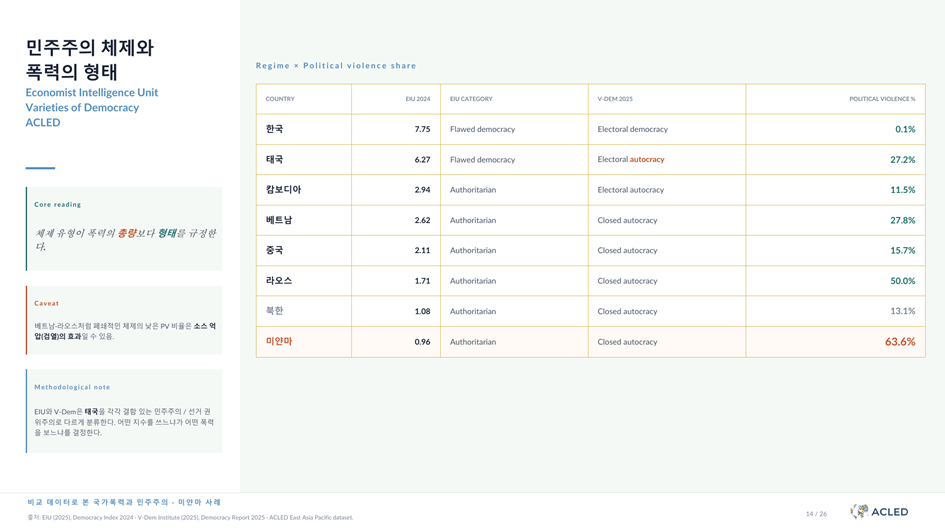
The seven-country comparison he presented at the seminar shows how politics is inscribed in each country’s data. Of the 48,470 events recorded in South Korea from January 2018 to July 2026, 99.7% were protests and political violence was just 0.1%. At the opposite end, Myanmar had 103,120 events, the largest in the region, with political violence at 63.6% and protests at 15.8%. Protests accounted for 75.9% in China (18,308 events), 53.7% in Thailand (5,854), 81.6% in Cambodia (751) and 64.8% in Vietnam (176). In Laos (22 events), political violence made up half.
Overlaying EIU and V-Dem regime indices on this, he summarized: “Regime type determines the form of violence more than its total volume.” In South Korea, a “flawed democracy” scoring 7.75 on the EIU index, peaceful protest stands out. In Myanmar, an “authoritarian” regime scoring 0.96, physical violence stands out. ACLED strictly defines a protest as “a public, nonviolent, in-person gathering of three or more people,” so it does not count symbolic acts, strikes without a gathering, one-person protests or online campaigns.
- You’ve watched five years of post-coup Myanmar through data. Have you thought about turning this into a book or writing?
=I have two concerns. One is that I haven’t majored in or continuously studied Myanmar. I’m someone who has only looked at the data. Covering eight countries, when a Thailand–Cambodia conflict breaks out I have to dig into that; when U.S.–South Korea joint exercises are scaled back, I study North Korea; when there are blank-paper protests, I study China. I always wonder whether I, not being an expert in one field, can really speak for them.
The other is the problem of the outsider’s voice. When I was studying international affairs, I watched Western friends spend six months in India or Cape Town and then write about the region and win research grants. I wondered whether they were taking away stories that local people should be telling. One of my researchers once shared a post criticizing a foreign university’s Myanmar conference whose panel was filled entirely with foreigners, and seeing it, I thought, “I shouldn’t do this.” So if I were to write or take on that kind of work, I’d start by making clear that it’s the perspective of a Korean researcher and an outsider.
- What are the data trends over five years since the coup, and how has the pattern of violence changed under the latest military leadership in 2026?
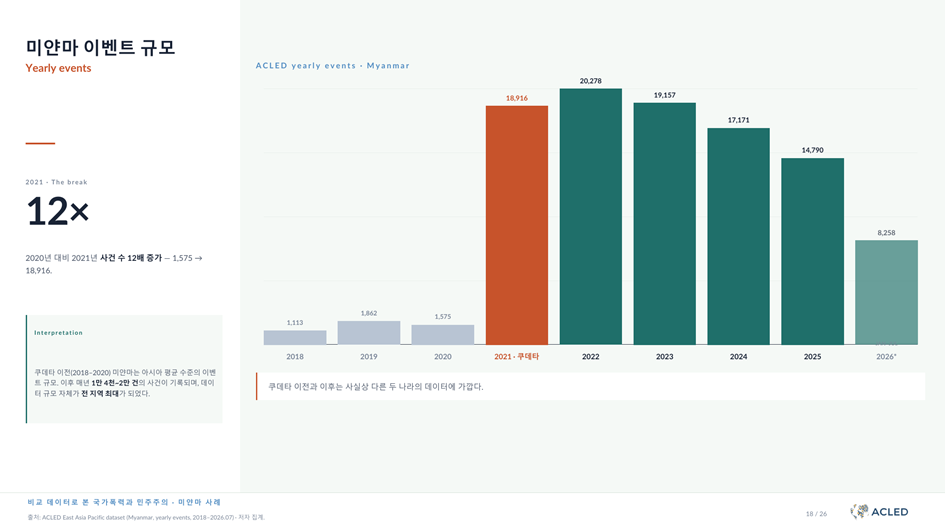
=The February 1, 2021 coup was a massive inflection point in the data. The annual number of events, 1,575 in 2020, rose twelvefold to 18,916 in 2021.
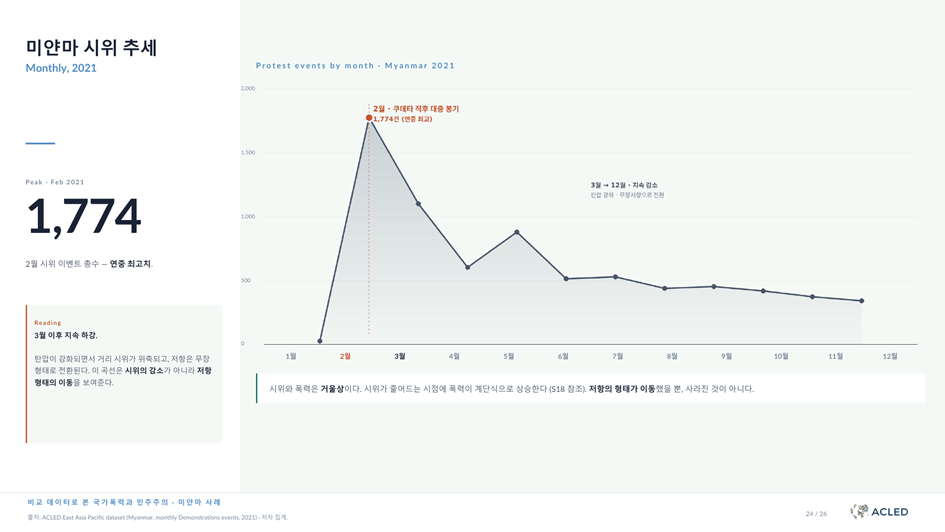
What stood out most was the clear decline in protests. The Civil Disobedience Movement (CDM) protests, most vigorous right after the coup, decreased and began turning into armed conflict. Protests peaked in early February 2021, right after the coup, with around 100 recorded per day between February 7 and 12. They dropped sharply from late March. By April they were half of March’s level, rebounded briefly in May, then declined gradually to the current level of a few dozen a month. This doesn’t mean resistance disappeared. It means that as the People’s Defense Force (PDF) and the National Unity Government (NUG) formed, resistance shifted to armed struggle from around April–May. The nature of protests changed too. Early on, many protests were met with crackdowns, but from 2022 that almost disappeared, and protests narrowed to areas centered on Sagaing.
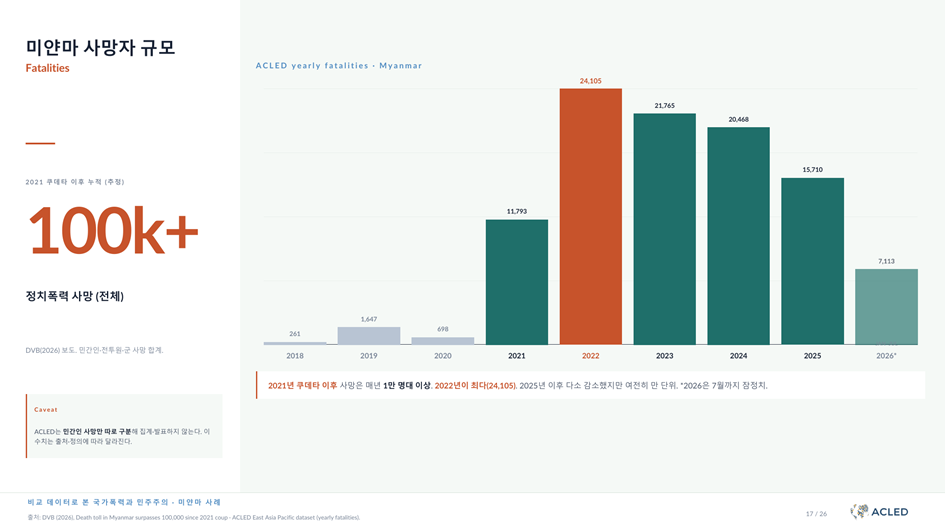
Since the coup, 14,000 to 20,000 political violence events have occurred each year, and the cumulative death toll has exceeded 100,000. The pattern of armed conflict has also kept changing. Battles are still the most common, but with airstrikes and drone incidents increasing recently, we see a trend in which the agent of killing is not a person but a machine — perhaps even AI. We could confirm through data that this isn’t just Myanmar’s problem. It’s connected to drone warfare in Ukraine and to China’s role.
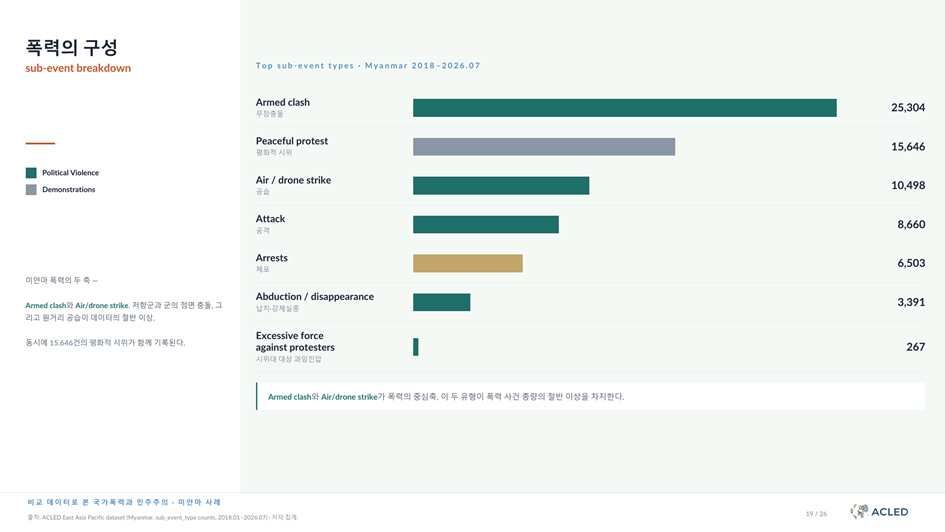
I think the military shifted its center of gravity to airstrikes because its existing strategy wasn’t working. There are two contexts. One is a strategic shift to recover territory lost to ethnic armed organizations and the NUG/PDF after Operation 1027. That was a large-scale joint offensive launched in northern Shan State on October 27, 2023, in which the military suffered heavy defeats. The other is conscription. The military changed its approach to fill its ranks while gaining strategic advantage. China’s role is significant here. Ethnic resistance forces find it hard to make equipment like drones without China’s cooperation, while the military is linked to the Chinese government. In fact, there have been repeated cases where strategic villages and townships were returned to the military after three-way negotiations among the Chinese government, ethnic resistance forces and the military. I believe the interests of Chinese capital in the border regions were at play.
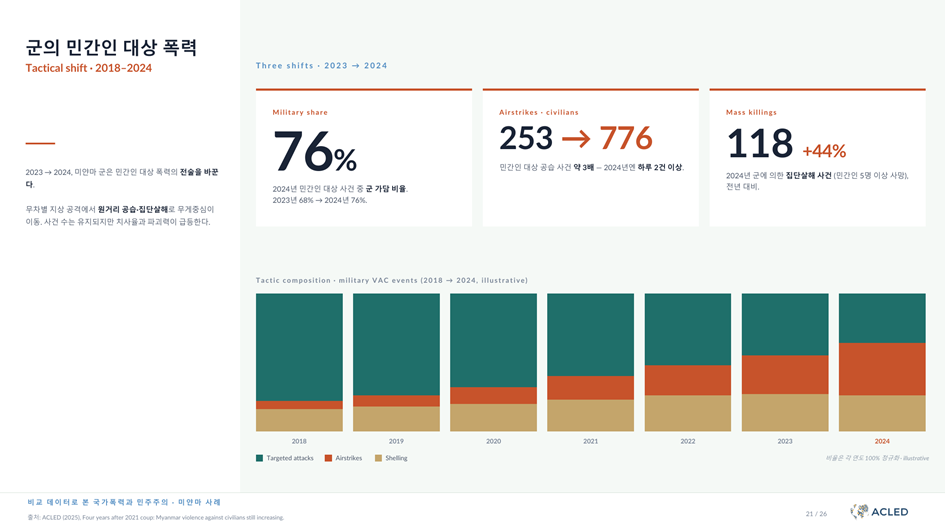
That said, you can’t say either side has the upper hand. After Operation 1027 there was talk that the resistance had gained the advantage and the war would end. But our team’s analysts expect the current stalemate to continue. The military will try to gain the upper hand through airstrikes and drones, but the territory it recently regained came back through its ties with China, not airstrikes. So unless there’s some trigger, things won’t change much. I agree with that analysis. Meanwhile, the military is working hard to secure legitimacy. Min Aung Hlaing’s visits to Thailand, China and India after becoming president, and the release of photos of Aung San Suu Kyi meeting the Red Cross, may be gestures of that kind.
- With digital surveillance and repression intensifying, has your data collection method changed?
=It’s something I think about periodically. After the coup, many media outlets shut down or moved their headquarters abroad, to places like Thailand, and eventually moved to Facebook. But did they win the information war there? Not really. The military spreads propaganda on Facebook in the same way, through outlets like Eleven Media. So we try to pick and code the most conservative, fact-based accounts among them. Myanmar isn’t a country that speaks only Burmese, so we also try to analyze sources in other languages like Chin and Shan, and we work with local partners like Myanmar Peace Monitor (MPM). We recognize and accept that partners may not be politically neutral. In Rakhine, we also receive material from local groups that don’t disclose their names, to protect their identities, and record Rohingya-related events.
Recently we added two sources, Rohingya Khobor and AK Media, whose positions on the Arakan Army are complete opposites. For the same incident, one reports that the Arakan Army killed Rohingya, while the other reports that the military did. When reports conflict over the perpetrator like this, we code the perpetrator as an “unidentified armed group” and record both claims in the Note Column. We publish that methodology in the Knowledge Base.
- Through the “Myanmar model,” what direction for reading data and building solidarity should Korean society consider?
=In South Korea, there was virtually no state crackdown on protests., only six involved excessive force. Even right after the December 2024 martial law declaration, protests rose from 450 to 835 a month and spread peacefully nationwide, enough that Seoul’s share fell from 40% to 25%. In Myanmar, by contrast, protests went from 36 in the month before the coup to around 1,800 the next month, then shifted to armed conflict after crackdowns. From the same kind of trigger, the two societies took completely different paths.
The “Myanmar model” is an outlier: among military coups in the East Asia–Pacific region, it is the one where civil war is still ongoing. At the same time, it’s a reference point recorded under the same rules — who, what, where, when — so it can be compared with other countries on the same scale. So I’d first like to propose placing other coup cases on the same scale. We could examine what choices other countries made in similar situations and what role those choices played in avoiding civil war. In doing so, we must keep in mind that the stronger the repression, the less gets recorded at all, and that the timing and density of data collection differ by case, so the comparison isn’t distorted. Then I hope we can sort out which of other countries’ choices are possible in Myanmar and which aren’t, and think together about what kind of solidarity we can offer within that.
News from Myanmar flows by as individual incidents and is quickly forgotten. Data binds those incidents together under the same standard — who, what, where, when — and lets us see the whole picture. To keep from losing sight of this reality amid the flood of news, we need a way of reading data together. On that basis, I’d like to talk together about what kind of solidarity Korean society can offer.
Reporting·Translation Seulki Lee (DUNIA Editor-in-Chief, Journalist) – skidolma@thedunia.org
Editing Yongjin Kim