The Flood South Asia Saw Coming
By Seulki Lee (DUNIA Editor-in-Chief, Journalist) – skidolma@thedunia.org
The glacial bedrock collapse that struck the Nepal-China border on 26 August 2026, and the catastrophic flood it triggered, delivered a stark reminder: the Himalayas function as a vast natural water tower, but only within a narrow band of climate conditions.
The collapse of ice and rock at altitudes above 7,000 meters killed hundreds, left roughly a thousand people missing, and displaced countless others from their homes.
Across South Asia such as in Nepal, India, Bhutan, Pakistan, and Bangladesh, nations that share the rivers flowing down from the Himalayas, newsrooms have refused to call this a natural disaster. Instead, they are framing it as a foreseeable, man-made catastrophe born of global negligence and the climate crisis, and calling for collective solidarity and preparedness.
Nepal: "This Damage Was Man-Made"
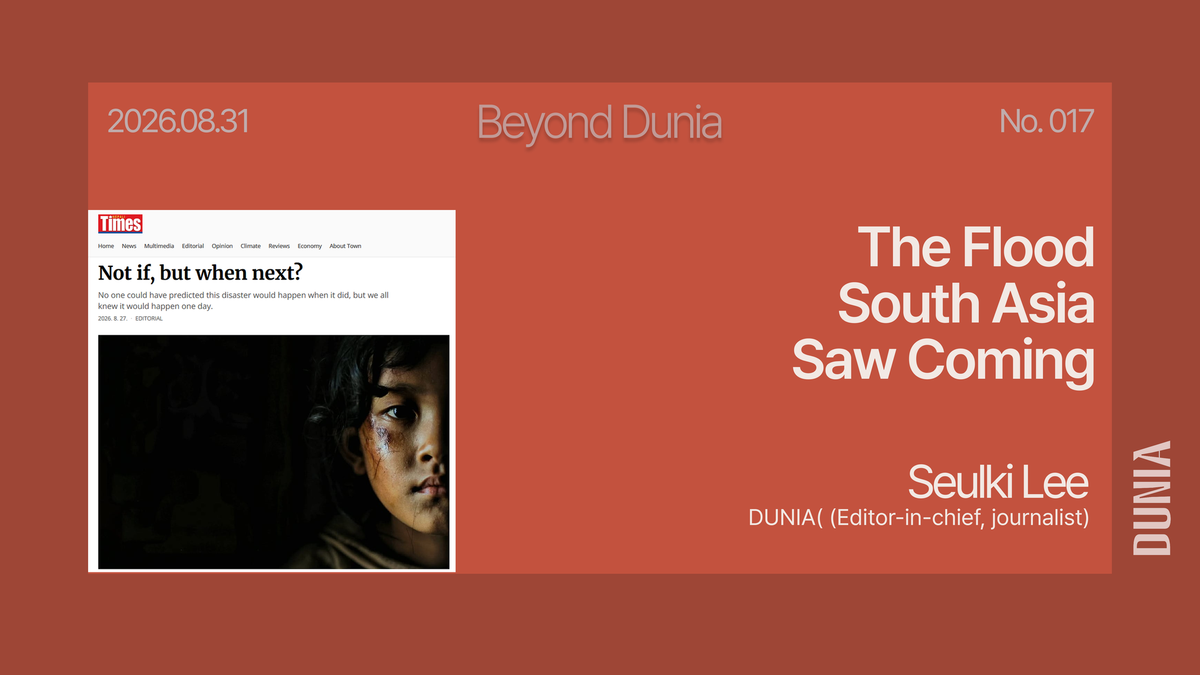
The most anguished self-examination has come from within Nepal itself. The day after the disaster, the country's leading English-language weekly, Nepali Times, ran an editorial under the headline: "Not if, but when."
The paper argued that the catastrophe was driven not only by greenhouse-gas-fueled warming, but by weak governance and corruption, successive governments that allowed roads and costly hydropower plants to crowd into flood- and disaster-prone zones, while riverside settlements kept expanding unchecked.
Nepali outlets insist this was never an unpredictable "act of God." Rising temperatures from fossil fuel emissions are indeed melting the glaciers, they acknowledge but the deeper problem is reckless development pursued in full knowledge of the risk, compounded by a culture of complacency about safety.
India: Accepting the Limits of Prediction, Turning to Law
Nepal's tragedy is no distant concern for its neighbors. Two days after the flood, on 28 August, India's English-language daily The Hindu published an editorial titled "Danger from Above: On the Nepal Flood," invoking the memory of the October 2023 glacial lake outburst flood in Sikkim. Rather than placing faith in scientific forecasting, the paper argued, Himalayan nations across South Asia need legal and regulatory preparedness.
Predicting the precise moment a glacier will collapse is, the editorial noted, close to technically impossible in real time. What governments can and must do, it argued, is enforce legal standards that sharply restrict unchecked mega-projects and settlement construction in hazard zones.
Bhutan: A Call to Rethink the Disaster Model
Bhutan has its own history with this kind of catastrophe, having suffered the 1994 Lugge Tsho glacial lake outburst flood. On 29 August, the Bhutanese online outlet Business Bhutan published an editorial headlined "A Disaster Next Door, A Warning for Bhutan," noting that the Nepal flood was a compound debris flow driven by both glacial and rock collapse.
Given that Bhutan, like other Himalayan regions, concentrates its hydropower plants, roads, and transmission lines along narrow valley corridors, the paper argued for integrated disaster scenario planning across entire river basins.
This new category of high-altitude hazard, where glaciers and bedrock collapsing together to produce compound debris flows, as seen in Nepal, is outpacing existing, piecemeal monitoring systems, the editorial warned.
For Bhutan, where power grids, roads, and villages cluster tightly in narrow valleys, a full reassessment of disaster models that account for landslides and glacial collapse occurring in tandem is now urgent.
Pakistan's press has struck a similar note. Home to the largest volume of glaciers outside the polar regions and thousands of glacial lakes, Pakistani commentary has stressed that this disaster is no "black swan", but it is a routine risk in an era of accelerating climate change, demanding thorough, proactive preparedness.
Bangladesh: Solidarity as Survival
Bangladesh, sitting at the point where Himalayan-fed rivers meet the sea, is a country long familiar with flooding, and its press is now calling for a jointly built, region-wide glacier monitoring and real-time early warning network. On 27 August, the English-language daily The Daily Star published an editorial titled "Nepal's Grief Is Ours Too," arguing that solidarity among South Asian nations tied together by Himalayan rivers is a matter of direct national interest and survival, not charity.
Reporting Seulki Lee (DUNIA Editor-in-Chief, Journalist) – skidolma@thedunia.org