Post-War Japan’s Worst Labor Crackdown: Unions Stand Against 'Hostage Justice'
By Seulki Lee (DUNIA Editor-in-Chief, Journalist) – skidolma@thedunia.org
In 2018, the most severe crackdown on the labor movement in Japan’s post-war history took place. Following a general strike led by the Kansai Nama-con Branch (hereafter "Kannama") of the All Japan Construction and Transport Solidarity Union, the police arrested over 80 union members in a massive sweep.
Despite their actions being legitimate union activities without any violence, Japanese investigative authorities and the judiciary branded them as "anti-social forces." They subjected them to prolonged detention under a practice known as "Hostage Justice" (Hitajiki-shiho). This past March 25, representatives from the Kannama branch visited Busan, South Korea. During their two-day stay, they met with the Busan regional headquarters of the Korean Confederation of Trade Unions (KCTU) to share their experiences of labor suppression and struggle.
During their visit, Dunia interviewed the Kannama members and their legal counsel to discuss the Japanese government’s crackdown process. Through this interview, we report in-depth on the full story of the 2018 suppression and the reality of a Japanese judicial system that has devastated the lives of labor activists.
Planned Investigations: Turning Legal Union Activity into 'Crime'
As an industrial union branch, Kannama has significantly improved the poor working conditions of ready-mix concrete truck drivers through strong collective bargaining power. Yamamoto Satoru, an executive member with 26 years of experience as a driver, stated that before joining the union, he earned about 300,000 yen for 18 days of work. After joining, he earned over 400,000 yen for the same number of days and was guaranteed legitimate working conditions, including overtime pay.
The growth of the union was a thorn in the side of capitalists. After the Osaka Regional Ready-Mix Concrete Cooperative was formed in 2015, the employers conspired with the police to orchestrate the destruction of the union. Investigative authorities fabricated cases by dredging up events from years prior.
The charges leveled by the police against union members were beyond common sense. According to Kannama attorney Kubori Fumi, member Yoshida Osamu was arrested on charges of "attempted coercion" simply because he requested a certificate of employment from the company to enroll her child in a daycare center. Another member, Matsumura Kenichi, was detained for "forcible obstruction of business" and "attempted coercion" after he went to protest and demand an apology from an employer who brought organized crime members to the union office.
Attorney Nakai Masahito explained that the suppression cases are largely divided into the Shiga Incident and the Kyoto Incident. In the Shiga case, legitimate "compliance activities"—where the union pointed out the lack of safety equipment or legal violations at construction sites—were transformed by investigators into "obstruction of business" and "extortion." There were no instances of intimidation or threats on-site.
In the Kyoto case, investigators reportedly pressured employers to frame themselves as victims by reopening past issues that had already been resolved through labor-management agreements, effectively creating a "planned investigation."
The Ignorance of the Judiciary and the Tragedy of 'Hostage Justice'
Such investigations and prosecutions are rooted in the judiciary's ignorance and prejudice regarding labor law. Yukawa, the current Chair (Vice-Chair at the time), recalled asking a judge issuing a detention order, "Do you know the Labor Union Act?" to which the judge clearly replied, "I do not." Attorney Kubori Fumi also pointed out that judges lack understanding of labor law and strikes, often viewing union activities through the prejudiced lens of "violent gang-like behavior."
The "Hostage Justice" system is cited as the biggest flaw in the Japanese judicial system. It refers to the practice of denying bail, restricting visits, and detaining suspects for long periods if they deny charges, effectively forcing confessions and neutralizing the right to defense.
Chair Yukawa was detained for a staggering 644 days under this system. He recounted how the police lured him home by using his sick mother without a single phone call, then mobilized 15 detectives to handcuff him. During his detention, a "ban on contact" was imposed, preventing him from seeing anyone except his lawyer for all but one week. He spent approximately 420 days in a holding cell with only a thin mat on a concrete floor, suffering from back injuries, asthma, and angina.
Executive member Yamamoto Satoru was also detained for 102 days. He exercised his right to remain silent during daily 2–4 hour interrogations. Rather than seeking the truth, the investigators constantly pressured him to quit the union and spoke ill of the organization.
These harsh environments eventually forced some activists to yield. Mr. Ohaku, who had been active since 2003, was arrested in 2018 and held for 46 days. Despite trying to remain silent, he eventually broke under the psychological pressure of isolation from his family. Desperate to escape, he admitted guilt and left the union after the verdict.
Chair Yukawa denounced the system, stating, "Japan's 99.9% conviction rate is fabricated by 'Hostage Justice'." Attorney Kubori added that without this system, no one would have been forced to falsely admit guilt or leave the union.
The Direction of Society and the Remaining Struggle
Why is such extreme labor suppression possible in Japan? Interviewees pointed to a right-leaning political environment and a divided civil society. Chair Yukawa warned that under conservative administrations following the ideology of Shinzo Abe, Japan is attempting to return to being a "war-capable nation." To achieve this, the government suppresses civic groups and unions while failing to teach labor law or correct history in schools.
However, the embers of hope remain. Mr. Ohaku, who originally left the union to escape prison, returned to Kannama in 2025 after witnessing horrific human rights violations while working for the employers' cooperative.
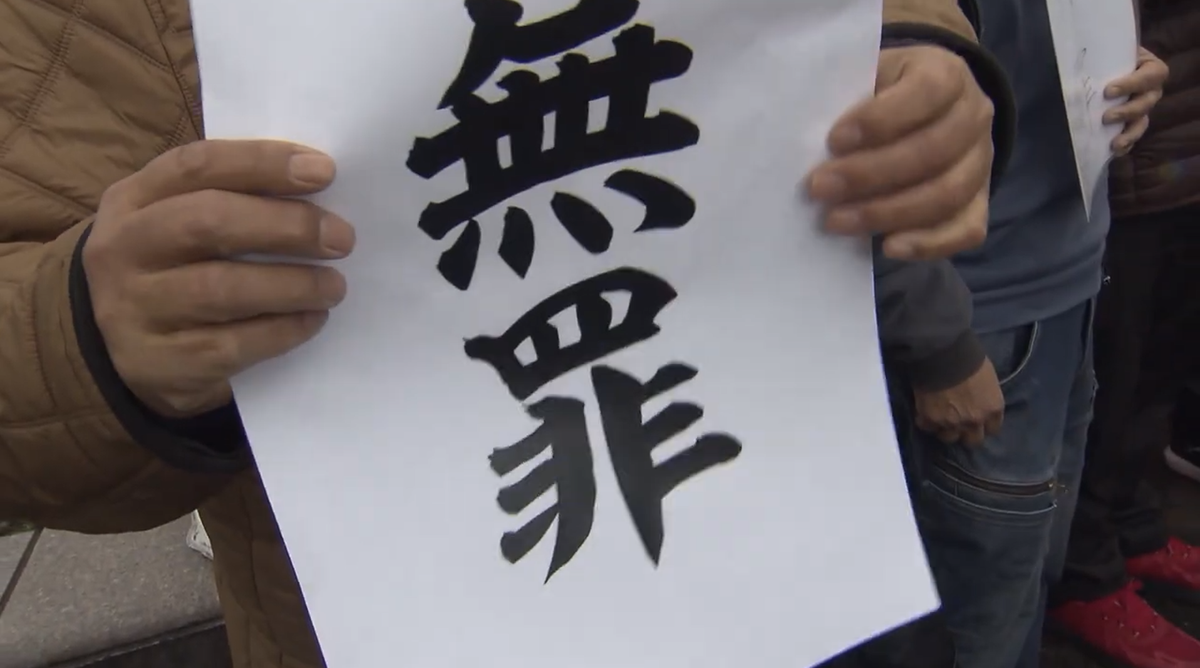
The legal battles continue. According to Attorney Nakai, all four of the most heavily fabricated Kyoto cases resulted in not-guilty verdicts at the first instance, though prosecutors have appealed. In the Shiga case, some members' innocence has already been finalized.
"A crisis is an opportunity," said Chair Yukawa. Despite a union density rate that has fallen to 16–17% in Japan, the members of Kannama continue to fight against state and capital power, calling for international solidarity to abolish the barbaric "Hostage Justice" system and protect constitutional rights.
Reporting Seulki Lee (DUNIA Editor-in-Chief, Journalist) – skidolma@thedunia.org