Sri Lanka’s Unbroken Spirit In The Wake Of Cyclone Ditwah
By Methmalie Dissanayake (Colombo-based Journalist)
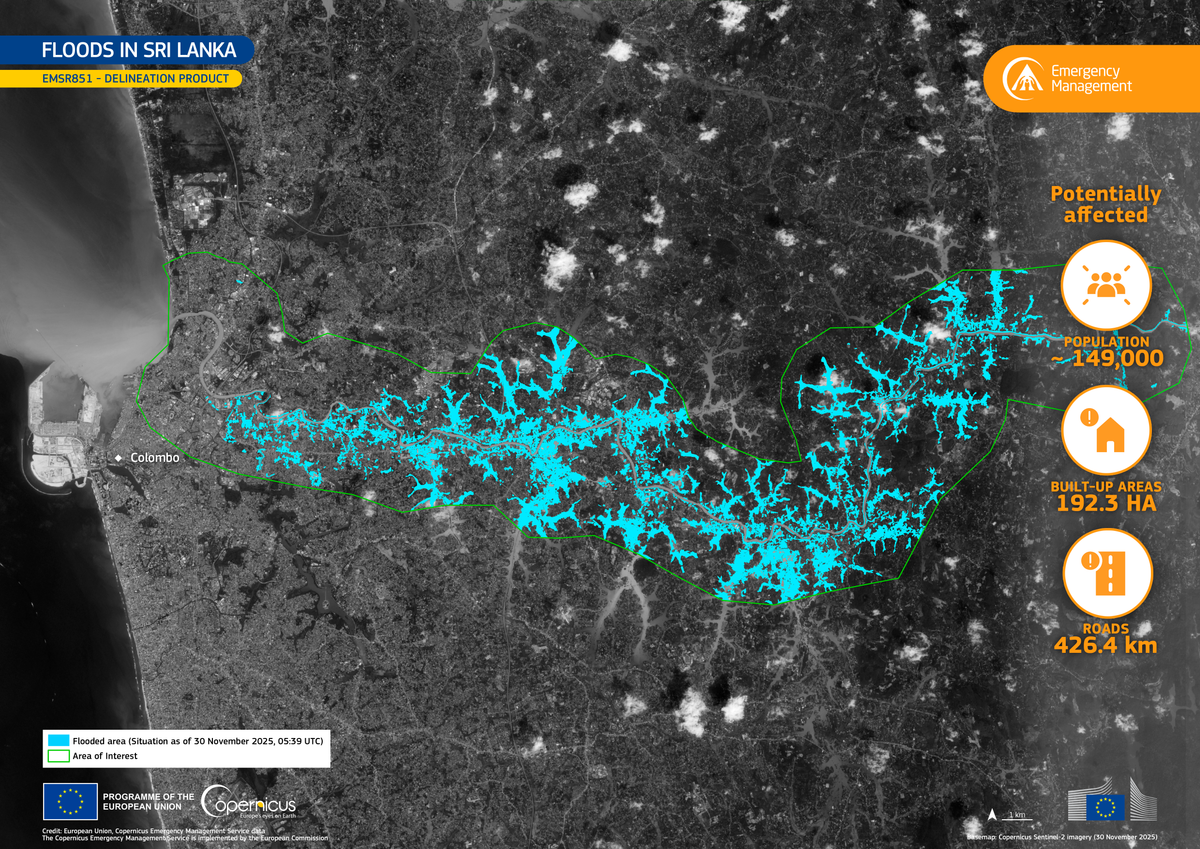
In the waning days of November and the turbulent onset of December 2025, the teardrop-shaped island of Sri Lanka was subjected to a meteorological siege that has fundamentally redefined its vulnerability in the age of climate acceleration. Cyclone Ditwah, a name that will now be etched into the national consciousness alongside the tragedies of 2004 and 2016, began as an innocuous low-pressure system before mutating into a catastrophic engine of destruction. It unleashed a deluge of biblical proportions, triggering massive flooding and earth-shattering landslides across 22 of the nation’s 25 districts.
As the floodwaters begin to recede, they reveal a landscape of grief: as of 7 December 2025, the crisis has claimed 627 lives, with 190 souls still missing and over 1.5 million people directly affected. This was not merely a weather event; it was, as formally declared by President Anura Kumara Dissanayake, the “largest and most challenging natural disaster in our history,” presenting a monumental test for a resilience that is written into the very DNA of this island nation.
Unprecedented destruction
For a country historically unaccustomed to the direct ferocity of cyclones, Ditwah arrived as a profound shock to the system. While Sri Lankans are no strangers to the caprices of the monsoon, the sheer scale of this devastation has paralyzed the island in a way reminiscent of, yet distinctly different from, the 2004 Tsunami. While the tsunami was a coastal tragedy that claimed nearly 40,000 lives, its fury was geographically contained. In stark contrast, Cyclone Ditwah has pierced the heart of the country, ravaging the Central Hill Country and interior districts that were once considered safe havens from coastal storms. Infrastructure has crumbled under the weight of the water; vital communications networks have collapsed, and the essential arteries of the nation—roads, water lines, and electricity grids—have been severed.
The human toll is devastatingly intimate. In the hill districts, entire families have been buried under sodden earth as landslides tore through tea plantations and villages. Survivors now face the agonizing duality of mourning lost loved ones while enduring the trauma of isolation, cut off from the outside world by communication blackouts. The United Nations Children’s Fund (UNICEF) estimates that approximately 20,000 children are among those most severely affected, facing displacement and the loss of the security that defines childhood.
The brutality of the disaster lay not only in the cyclonic winds but in the unprecedented intensity of the rainfall on ground that was already critically saturated by five preceding days of heavy precipitation. On 28 November alone, the heavens opened to dump nearly 10% of the country's annual rainfall in a single day, with some locales recording over 350mm in 24 hours against an island-wide average of 200mm.
The climate catalyst
The scientific context of this tragedy serves as a grim warning for the future. Dr. Lakshman Galagedara of Canada’s Memorial University, speaking to the BBC, provided a staggering metric to comprehend the volume of water involved. He calculated that the water discharge intensity per square kilometer during the peak of the deluge was significantly higher than the average discharge rate of the Amazon River. With the soil unable to absorb this sudden aquatic load, the result was immediate and catastrophic flash flooding, followed by the deadly landslides that accounted for the highest concentration of fatalities. The Central Hill Country bore the brunt of this geological failure, with the districts of Kandy, Badulla, and Nuwara Eliya recording 232, 90, and 89 deaths respectively.
Scientific analysis strongly links this extreme event to the broader global climate crisis, signaling a new era of risk for the Indian Ocean region. Professor Charitha Pattiaratchi of the University of Western Australia noted that sea surface temperatures around Sri Lanka had soared past the crucial 30°C mark—well above the 27°C threshold typically required to sustain cyclonic activity. This thermal anomaly essentially super-charged the storm, granting it a destructive power previously unseen in this latitude. While the island has experienced periodic cyclones, global warming is increasing both the frequency and the scale of these events. Unlike past storms that were often localized, Ditwah’s cloud cover and impact spanned virtually the entire nation. Experts now warn that despite modern communication and early warning systems being vastly superior to those of previous decades, the sheer intensity of climate-change-driven storms demands an urgent, fundamental shift in public preparedness and land-use habits.
A regional crisis and geopolitical thaw
The devastation was not confined to Sri Lankan shores. Cyclone Ditwah acted as a regional wrecking ball, devastating neighboring nations and claiming over 1,500 lives across Southeast Asia. Indonesia confirmed nearly 900 deaths, Thailand mourns over 185 lost, and Malaysia has confirmed three casualties. Yet, it is in the response to this regional agony that the complexities of geopolitics and the simplicity of human compassion have intersected most poignantly. The immediate response within Sri Lanka has been a massive, multi-faceted operation, a testament to domestic resilience bolstered by robust international support. The Sri Lankan Tri-Forces have led the primary relief operations, but they were swiftly joined by regional partners in a display of disaster diplomacy.
In a remarkable development that momentarily bridged a deep geopolitical divide, the urgency of the catastrophe necessitated cooperation between nuclear-armed neighbors India and Pakistan. The Indian military, under 'Operation Sagar Bandhu,' was among the first to deploy, providing relief material and search and rescue teams. Simultaneously, the Pakistan Navy dispatched aid. In a move that underscores the gravity of the humanitarian crisis, President Dissanayake requested New Delhi to allow Pakistani relief flights to cross Indian airspace—a corridor that has been closed to each other’s aircraft since tensions escalated in April. India’s assent to this request, allowing aid to flow unimpeded to a neighbor in need, stands as a flickering beacon of how shared vulnerability can occasionally trump political entrenchment.
The international community’s mobilization has been swift and substantial. The United States, through INDOPACOM, provided critical airlift and logistics support, deploying C-130J Super Hercules aircraft to ferry essential supplies into the hardest-hit, isolated highlands. Financial and material aid has poured in from across the globe, reflecting Sri Lanka's longstanding diplomatic relationships. A "Maldivian with Ceylon" telethon raised over USD 800,000, a significant sum from the small archipelago nation, supplemented by government donations of canned tuna. Nepal, Bangladesh, the UAE, and the UK have all contributed funds and emergency supplies ranging from mosquito nets to rescue vehicles. Japan, through JICA, deployed a 31-member medical team to Chilaw, while China pledged a combination of state and private sector aid totaling millions of dollars.
The instinct of giving: "Blood Dansala"
However, amidst the roaring waters and the international convoys, the most powerful story to emerge from the wreckage of Cyclone Ditwah is not one of foreign aid or government decrees, but of the indomitable spirit of the Sri Lankan people. To the outside observer, the phenomenon might seem miraculous; to a Sri Lankan, it is instinct. This operational success is deeply rooted in the island’s culture of Dana—the virtue of giving. Sri Lanka is one of the few developing nations to achieve 100% voluntary, non-remunerated blood donation, a milestone reached in 2014. This system relies not on coercion or financial incentives, but on a psychological contract of altruism between the citizen and the state.
In many parts of the world, a natural disaster forces people into a mode of survivalist self-preservation. Yet, by 2 December, the streets leading to the National Blood Transfusion Service (NBTS) headquarters told a different story. It was a narrative not of fear, but of defiance and overwhelming generosity. Despite the torrential rains and the logistical nightmares brought on by the cyclone, the people of Sri Lanka queued up. They stood in winding lines, waiting for hours not to receive aid, but to give of their own bodies. The response was so immediate and massive that the NBTS, which had initially feared a shortage due to the crisis, found itself facing a "problem" that is the envy of the global medical community: an abundance of generosity that exceeded all logistical expectations.
Dr. Lakshman Edirisinghe, Director of the NBTS, highlighted the magnitude of this response, noting that while the service issued an appeal to meet a daily requirement of 1,500 units, the public response far outstripped this need. The statistics arising from those four critical days are staggering: between 29 November and 2 December, the NBTS received over 20,000 blood units. Perhaps most heartwarming is the fact that among these thousands of donors, more than 5,000 were first-time volunteers—young men and women stepping forward for the very first time to answer the call of their country.
Last week witnessed a true "Dansala," proving that the drive to save a life is intertwined with deep-seated cultural and religious values. This spirit of giving is the hallmark of the land. Visitors during the holy months of May and June are familiar with the Dansals—free food stalls seen in every nook and corner during the Vesak and Poson festivals. Influenced by Buddhist culture and the island’s multi-ethnic fabric, Sri Lankans consistently come forward to help those in distress. The aftermath of Cyclone Ditwah was no different. Spontaneous community kitchens sprang up, established completely on a volunteer basis with no political involvement. One such kitchen in Wijerama, Nugegoda, provided nearly 100,000 food parcels to affected areas in the Western Province over a span of seven days. Citizens came forward with whatever they had—be it a single water bottle, a kilogram of rice, or fruit picked from their own home gardens—to feed fellow citizens in distress.
The solidarity extended beyond mere sustenance. People from non-affected areas, and sometimes even those from less-affected zones, lined up to clean the streets and mud-choked houses of strangers. In the southern coastal belt, fishermen loaded their boats onto trucks and traveled inland, using their vessels to assist in rescue missions in the flooded interior. It was a mobilization of the common man, a collective heave against the weight of the disaster. This wave of solidarity extended beyond the island's shores as well, with expatriate Sri Lankans donating to the government-established fund, which has now reached approximately LKR 700 million. President Dissanayake acknowledged this collective effort in Parliament, recognizing that the true strength of the nation lay not in its coffers, but in the hearts of its people.
The economic aftermath
Yet, as the waters recede, the economic reality emerging from the mud is stark. The long-term challenge is the national rebuilding, a "mammoth task" given the economic toll on a nation still recovering from the bankruptcy of 2022. Early government estimates suggest the cost of recovery and reconstruction could reach between USD 6 billion and USD 7 billion. This crisis has exposed deep structural vulnerabilities, with extensive damage to critical infrastructure, including highways and power networks, and the destruction of thousands of acres of farmland, threatening food security. Consequently, the government has urgently appealed for assistance from the local business community, the diaspora, and foreign donors.
The economic implications have reached the highest levels of international finance. President Dissanayake announced that he has asked the International Monetary Fund (IMF) to delay the release of the sixth installment of a USD 2.9 billion bailout loan.
The strategy is one of necessity: the government wishes to renegotiate for a larger payout to accommodate the unexpected costs of the disaster. “The IMF board was to sign off on releasing USD 347 million on December 15, but we have now asked them to put it off because we want time to negotiate a bigger installment," the Government told the AFP news agency.
The IMF has confirmed that Sri Lanka had requested an additional USD 200 million in financial assistance to address the cyclone damage, a request that is currently under consideration. In a statement, Evan Papageorgiou, IMF Mission Chief for Sri Lanka, reaffirmed the Fund's commitment to supporting the country as it undertakes urgent efforts to recover and rebuild.
Rebuilding and reflection
While the immediate focus is on relief, the disaster has inevitably sparked criticism and introspection regarding the nation's preparedness. There are growing voices of dissent regarding delayed responses for evacuations and questions as to whether authorities neglected weather reports and early warnings about the heavy rainfall. The opposition has threatened legal action, accusing the government of negligence. It is clear that Sri Lanka must move forward by identifying the loopholes in its Disaster Management System and investing heavily in public education.
Many citizens, perhaps lulled by a false sense of security from previous localized floods, ignored warnings to evacuate until the tragedy struck. The government has provided an extensive relief package for resettlement and infrastructure rebuilding, but the path to full recovery will require systemic changes in how the island manages its risks.
Amidst this gloom, there are glimmers of economic hope. The tourism sector, a critical lifeline for the feeble economy, remains resilient. While the hill country may take time to recover, Prime Minister Dr. Harini Amarasuriya has assured the world that the island nation remains safe for visitors. Tourism arrivals have not seen a significant decline, and in areas like the southern coast, business continues as usual. No tourists were harmed in the disaster, a fact the government is keen to highlight as tourism earnings are critical for the ongoing economic recovery. The message to the world is clear: Sri Lanka is wounded, but it is open, and its spirit is unbroken.
The scars of Cyclone Ditwah will be visible on the landscape for years to come, but the invisible legacy will be one of unity. In the face of a climate crisis that respects no borders, Sri Lanka has demonstrated a resilience that is both humbling and inspiring. From the queues at the blood banks to the fishermen navigating flooded streets, the people have proven that while the climate may be changing, the warmth and generosity of the Sri Lankan soul remain a constant, unyielding force against the storm. This is a nation that has looked into the eye of the disaster and found, in the reflection, the very best of itself.