The Iran War Voices the Media doesn’t report
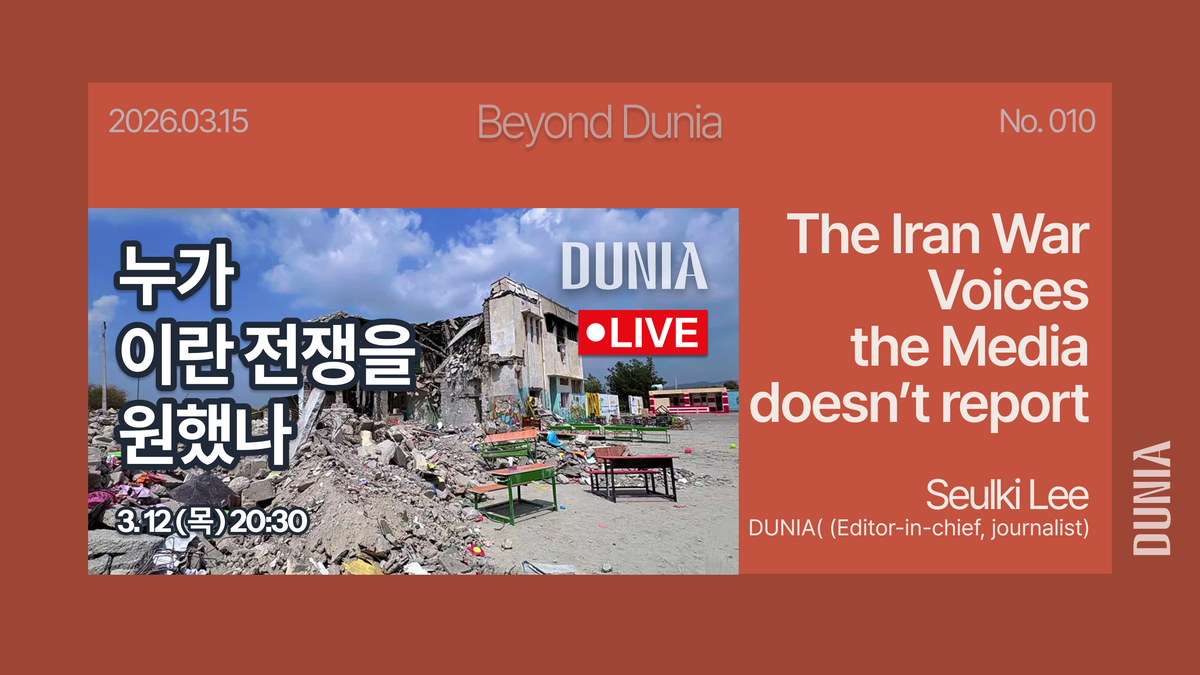
– Dunia Special Live Talk: "Who Wanted the War in Iran?"
By Seulki Lee
Following Pakistan’s airstrikes on Afghanistan on February 26 and subsequent strikes on Iran by the U.S. and Israel on February 28, a devastating war has once again erupted in the Middle East. Media outlets are flooded daily with battle maps, military analyses, diplomatic strategies, and reports on defense stocks. However, within this massive discourse, the voices of the citizens on the ground — where the bombs are actually falling—are being thoroughly excluded.
In response, Dunia, a non-profit independent media outlet founded in November 2025, hosted a live talk on March 12. Instead of military experts, the event invited a field reporter, civil society activist, and student of Middle Eastern studies. Titled "Who Wanted the War in Iran?". The discussion featured Yukyung Lee (freelance journalist specializing in international affairs), Myunggyo Hong (activist from Platform C, an international solidarity peace movement), and Jiwon Lee (a student majoring in Middle Eastern studies) to uncover the hidden truths behind the war.
A Meticulously Planned Invasion and the Deceptive Pretext of "Regime Change"
The panelists agreed that this war was not an accidental clash but a meticulously planned invasion by Israel and the United States. Journalist Yukyung Lee pointed out that on February 27, the day before the strikes, the U.S. Embassy in Israel ordered the evacuation of all non-essential personnel. She criticized this as a "backstabbing" maneuver that sabotaged ongoing negotiations mediated by Oman, which were nearing a concession from Iran.
The discussion emphasized that Israel is the primary driver of this conflict. The goal is not merely "Regime Change" but the "Total Collapse" of the Iranian system. This serves the "Greater Israel" agenda, seeking territorial and physical expansion within the Middle East.
While the U.S. and Israel cite Iranian democratization, the protection of women's rights, and the prevention of nuclear development as justifications for preemptive strikes, the panelists offered a sharp rebuttal. They noted that there is no historical precedent for democracy being achieved through external military intervention. As seen in the Afghan War, imperialist powers are once again using "women's rights" as a cheap bargaining chip to justify aggression.
Collapsed International Law and Brutal Civilian Massacres
The talk repeatedly stressed that the military actions of Israel and the U.S. constitute clear illegal acts and war crimes. Immediately after the war began, the Shajareh Tayyebeh Girls' Elementary School in Minab, Iran, was bombed, killing at least 168 young girls. Attacks have continued on hospitals, refugee camps in Lebanon, and fuel storage facilities.
Jiwon Lee noted that the international community failed to hold anyone accountable when children were killed and hospitals attacked in Palestine. Yukyung Lee warned that Israel has learned through the genocide in Gaza that "no one will stop them." She cautioned that as long as the culture of impunity persists, Israel’s expansion of the war will not cease.
Erased Voices of the Iranian People Amidst Distorted Public Opinion
A significant portion of the discussion focused on the marginalized voices of Iranian citizens and ethnic minorities. Western and South Korean media have disproportionately amplified the voices of the Iranian monarchists (Pahlavi supporters-editor’s note) or far-right groups in North America who welcome the war, framing them as the representative will of the Iranian people.
However, the reality on the ground is different. Iranian citizens, who had been protesting against the Islamic theocratic regime for nearly two months, have lost the momentum of their movement due to the external invasion and are being forced into silence. The Iranian Chief of Police has even threatened to prosecute anyone "speaking with the voice of the enemy" for treason, using the war to justify systemic oppression. Ironically, the U.S. strikes are serving to extend the life of the Iranian regime.
The panelists highlighted statements from Iranian progressive circles and labor unions ignored by mainstream media. The March 8 Women’s Organization declared that the U.S. and Israel are continuing the slaughter for their own interests and power, asserting that the Iranian people must create an oppression-free society themselves. The Iran Labor Federation also criticized both the invasion and the Islamic Republic, stating, "The working class has nothing to gain from war." Kurdish exile governments and parties also reacted strongly, refusing to be treated as "chess pieces" in a proxy war between the U.S. and Iran.
Media Obsessed with "K-Defense" Booms and a South Korean Government’s Silence
The dire state of South Korean media, which should be reporting on the tragedy of war, was also criticized. Instead of covering civilian massacres or diverse civil society voices in Iran, the media has focused on sensationalist reports regarding the surge in "defense stocks" like LIG Nex1 and fluctuations in international oil prices. Nationalistic reporting often highlights the "prowess" of K-Defense weaponry while ignoring the horror of "double-tap" strikes and local suffering.
A bigger issue lies with the South Korean government. Myunggyo Hong of Platform C strongly criticized the Jaemyung Lee administration’s actions, such as meeting with the Israeli ambassador shortly after taking office. He pointed out that the government lacks a clear diplomatic philosophy, engaging in ambiguous "tightrope diplomacy." He warned that by failing to take a firm stand against war crimes and instead exporting interceptor missiles to the UAE, South Korea risks becoming an accomplice in the destruction of international law.
The panelists mentioned that middle powers like Spain have taken strong diplomatic measures, such as recalling their ambassadors from Israel. They urged the South Korean government to stop merely praising its own democratic and economic achievements and instead issue a clear condemnation of the invasion and the massacre of elementary students, suggesting measures as strong as the expulsion of the Israeli ambassador.
The Necessity of Global Anti-War Solidarity
Dunia’s YouTube live talk clearly confirmed that "this war is by no means the war the Iranian people wanted." In a war zone where bombs fall, the only winners are the power-holders selling weapons; the victims are ordinary citizens who had no part in the decision-making process.
Closing the session, the panelists emphasized looking at the situation from the perspective of Iranian citizens who oppose war, massacre, and oppression, moving beyond extreme hatred and camp logic. In a time when trust on rules-based order in the globe has collapsed and impunity reigns, they delivered a heavy message: solidarity among global citizens shouting for peace is the only hope to prevent total catastrophe.
Reporting Seulki Lee - skidolma@thedunia.org