What a Distant Vote Tells South Korea: The 2026 Bangladesh General Election
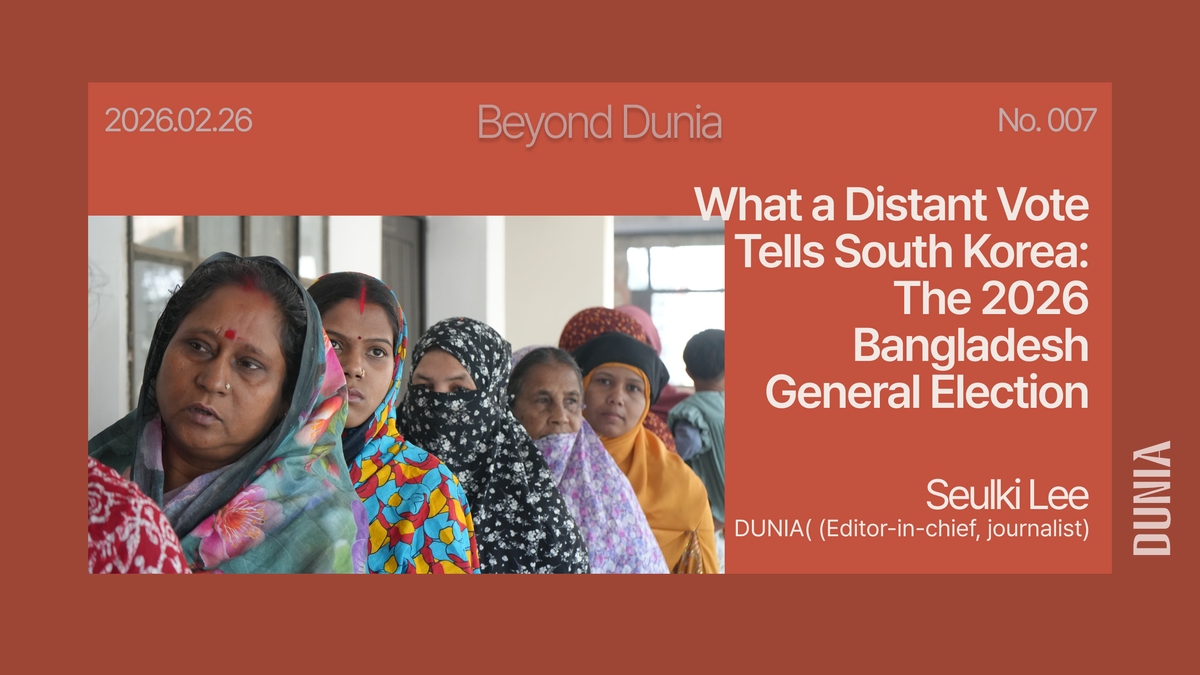
On February 12, 2026, Bangladesh marked a historic milestone with the definitive end of the Sheikh Hasina era—a regime that held power for 17 consecutive years. The landslide victory of the Bangladesh Nationalist Party (BNP) and the inauguration of Tarique Rahman as the new Prime Minister represent more than a mere political transition. This is a conditional opportunity built upon the sacrifices of countless citizens who bled while resisting autocracy in July 2024. While the upheaval in South Asia may feel distant, the drama of justice and recovery in Bangladesh is far from irrelevant to South Korea, where over 30,000 Bangladeshi migrant workers labor alongside us as of 2024.
The most profound issue this election poses to South Korean citizens is the challenge of redressing and healing state violence. According to reports from the Office of the United Nations High Commissioner for Human Rights (OHCHR), during the protests of July and August 2024, the Hasina regime deployed police, military forces, and even helicopters to fire indiscriminately at protesters with military rifles and shotguns. It is estimated that approximately 1,400 people, including children, were killed. Thousands more were blinded or left with permanent disabilities. The 2026 election was held atop this legacy of sacrifice. A 25-year-old voter’s confession—that he had "voted properly for the first time in his life and finally felt like a true citizen"—proves that this election was both a judgment on oppressive rule and a substantive restoration of democratic rights. The primary mandate for Tarique Rahman’s government is to uncover the truth behind these horrific state crimes and hold those responsible accountable.
Furthermore, the electorate has granted the new government conditional trust rather than blind allegiance. This reflects a shift in political culture—one that is also beginning to take root in South Korea—where politicians are viewed as contracted agents rather than heroic figures. Bangladeshi citizens are sternly warning the new administration not to repeat the corruption and violence of the past. As columnist Naziba Basher noted, this vote was not an expression of love for a politician, but a "calculated decision to choose the less dangerous side to prevent a greater risk." Citizens have demonstrated a mature civic consciousness, demanding that the new government uphold the rule of law and ensure safety in the streets and workplaces, while signaling their readiness to resist should these promises be broken. This serves as a potent reminder of a fundamental democratic principle: politicians should be seen as accountable representatives, not objects of worship.
Thirdly, the election suggests that the completion of democracy lies in inclusivity, not just the act of voting. While the international community praised the election as procedurally transparent and peaceful, it revealed a painful limitation: the marginalization of women. Despite women making up nearly half of the electorate (62.8 million), only seven women were directly elected to the 300-seat parliament. This is a sharp regression compared to previous elections. The decline is attributed to a surge in misogynistic rhetoric during the campaign and a reluctance among political parties to nominate female candidates. The outcry from women demanding structural protection over symbolic respect highlights a critical task: ensuring that the voices of the marginalized are not excluded once formal democracy is achieved.
Finally, the stability of Bangladesh is inextricably linked to South Korea’s economy and society. The newly formed BNP government faces the daunting task of resolving a severe economic crisis characterized by high inflation and a population of over 40 million living in extreme poverty. Currently, more than 9 million Bangladeshis—over 5% of the population—reside abroad as short- or long-term migrant workers in the Middle East and Asia. For the 30,000 Bangladeshi workers in Korea, their homeland's economic recovery is a desperate matter of survival for their families. The income they earn in Korea is a vital source of foreign exchange for the Bangladeshi economy; conversely, the political and economic stability of Bangladesh directly impacts the psychological well-being and productivity of these workers within Korea.
In February 2026, Bangladeshi citizens voted "to hold the next election with hope rather than fear." Their efforts to overcome the trauma of state violence and rebuild a shattered economy and democracy call for deep solidarity and reflection from South Korean citizens, who share a similar history of democratization. Democracy can collapse in an instant, but its restoration is a slow, painstaking process. Observing the pain and recovery of our neighbors is more than an act of empathy; it is our responsibility as global citizens and a testament to the maturity of South Korean society.
Reporting Seulki Lee - skidolma@thedunia.org