Did Yoon Suk-yeol Dream of Becoming Abe? Did the People Power Party Seek to Become Japan’s LDP?
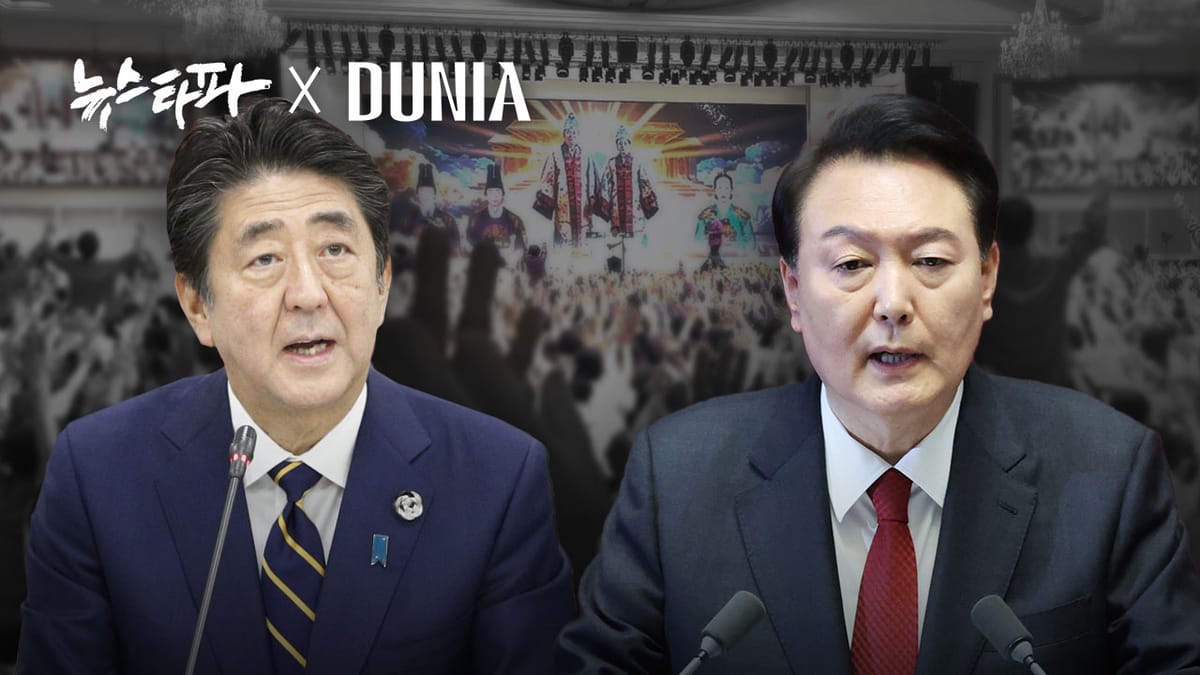
An unprecedented pact between religion and political power has been exposed. The financial and human networks of the Unification Church collided with the political power of Yoon Suk-yeol, resulting in the most extreme case of church–state collusion in Korea’s contemporary history. Some experts now argue that the scheme was essentially a copycat crime — an imitation of what the Unification Church perfected in Japan over decades.
Newstapa and Dunia traveled to Japan, where the Church spent more than half a century building its most sophisticated political influence model, to examine what kind of political order Yoon Suk-yeol and the Unification Church envisioned for South Korea.
Tetsuya Yamagami: “Abe’s support for the Unification Church motivated the shooting”
On July 8, 2022, former Japanese Prime Minister Shinzo Abe was assassinated in broad daylight.
The gunman, Tetsuya Yamagami, was a previously unremarkable man in his 40s whose mother was a longtime follower of the Unification Church.
According to Yamagami, the Church’s relentless demands for donations destroyed his family. On his now-deleted X (Twitter) account, he wrote:
“When I was 14, my family collapsed. The Unification Church forces members to offer everything—money obtained through theft, embezzlement, even fraud. My elderly grandfather, exhausted after the bubble economy burst, fell into despair and once even wielded a knife toward my mother.”
— Tetsuya Yamagami, posts on X
One day before the shooting, he sent a letter foreshadowing his intention:
“I despise Abe, but he is not my true enemy. He is simply one of the most influential defenders of the Unification Church in the real world. I have no capacity to consider the political consequences of his death.”
— Letter sent on July 7, 2022
Abe’s connection with the Church was unusually close. In September 2021, he even delivered a video message to an event organized by the Universal Peace Federation (UPF), an affiliated organization of the Unification Church.
Kishi Nobusuke: Abe’s Grandfather and the Origins of the Alliance
The relationship began in the 1960s under Abe’s maternal grandfather, former Prime Minister Kishi Nobusuke—one of Japan’s most influential postwar conservative political leaders.
Kishi and Unification Church founder Sun Myung Moon forged an alliance under the banner of anti-communism. Moon often boasted that he had played a decisive role in shaping Kishi’s political ascent.
Moon stated in a sermon:
“We brought Kishi Nobusuke—trusted across Japan—into our plan, together with Ryoichi Sasakawa. We made him dance to our tune. That is why we succeeded so magnificently.”
— Sun Myung Moon, The Sermons of Sun Myung Moon, Vol. 160
Makoto Watanabe, editor-in-chief of Tansa, an independent Japanese investigative newsroom that has reported on the Unification Church for decades, explains:
“In 1967, Moon, Sasakawa, and a representative of Kodama Yoshio met secretly at Lake Motosu in Yamanashi Prefecture. The following year, they formally launched the International Federation for Victory over Communism in Japan and Korea. The founding members were Kishi Nobusuke, Ryoichi Sasakawa, and Kodama Yoshio.”
— Makoto Watanabe, Tansa
According to Watanabe, the Church used its ties with the Abe dynasty and the ruling Liberal Democratic Party (LDP) to inflate its influence and expand rapidly in Japan.
Mutual Benefit: The LDP–Unification Church Political Machine
Watanabe explains that the Church strategically advertised its proximity to LDP politicians:
“They boasted: ‘Abe Shinzo sent a message to our event,’ or ‘LDP lawmakers attend our gatherings.’ They used this to exaggerate their power and attract more followers.”
So were the parallels with South Korea:
the Church allegedly courted Yoon Suk-yeol’s wife Kim Keon-hee, secured access to senior ruling-party officials such as Kwon Seong-dong, and attempted to influence major state affairs including the UN Secretariat campaign and Korea’s ODA strategy for Africa.
The Church’s Explosive Growth in Japan—Powered by the LDP
With protection from top LDP leaders, the Unification Church rapidly expanded its membership and fundraising in Japan.
Japanese courts have officially recognized massive damages from coerced donations—about 200 billion won (approx. USD 150 million). Over the past four decades, some estimates put total losses at over 120 billion yen (more than 1 trillion won).
Attorney Hiroshi Watanabe of the National Network of Lawyers Against Spiritual Sales notes:
“The Church teaches that members must offer all their assets to God. This destroys families. These books, for example, sold for as much as 30 million yen. Followers are pressured to buy four, even five copies.”
Former Japanese MP Yoshifu Arita describes the mutually dependent relationship as “like a crocodile and a plover bird”:
“For lawmakers, the Church provided free election support. For the Church, lawmakers pushed policies beneficial to them—such as promoting anti-espionage legislation in 1985 or opposing the adoption of separate surnames for married couples. This relationship remained hidden beneath Japanese politics until Abe’s assassination exposed everything.”
What Happened in Japan Could Have Been Korea’s Future
The Unification Church built its political machine in Japan over decades—quietly, strategically, and successfully.
A similar trajectory was possible in South Korea.
Had the corrupt dealings between Yoon Suk-yeol, Kim Keon-hee, and the Unification Church not surfaced…
Had Yoon’s unconstitutional martial-law conspiracy succeeded and silenced investigations…
South Korea could have slid toward a system where political power and a specific religious organization merged—where national policy bent to the interests of that organization, much as the Church once aspired to do in Japan.
Reporting Seulki Lee - skidolma@thedunia.org