Asian Cities’ Unaffordable Housing Equation
By Seulki Lee (DUNIA Editor-in-Chief, Journalist) – skidolma@thedunia.org
At twenty-five, in a room barely larger than a closet in a goshiwon, Korea's cramped, dormitory-style micro-housing, in Seoul's Sillim neighborhood, I sat hunched over a general-knowledge study guide, cramming for the journalism entrance exams that would decide my career. I watched my bank balance shrink month by month. Back then, I hadn't even begun to calculate what it would take to afford a room of my own in this city.
For the twelve years that followed, I made cities across Asia my base as a freelance correspondent. In a kos, Indonesia's version of a boarding house, in South Jakarta, I fell asleep to the drone of cars and motorbikes outside my window. In Kuala Lumpur, I split a room in a three-bedroom apartment with a friend, wrestling with the rent every month.
In Nepal, I rented a room in a family home in Patan, in the Kathmandu Valley, and learned to live with the power outages. In South Delhi, I stayed in a PG, a "paying guest" arrangement, facing windowless walls. No matter which city I landed in, the housing stress never let up. My income crept upward, year after year, but a home of my own always stayed one step ahead, just out of reach.
At thirty-seven, when the Covid-19 pandemic grounded my life as a roving Asia correspondent and stranded me back in Korea, I found myself in Sillim once again. This time, in a semi-basement — a banjiha. Twelve years apart, in the same neighborhood but in a different kind of room, I was finally, for the first time, doing the math in earnest: income minus rent, what's left minus savings. And still, the numbers refused to add up.
As a journalist, and now as the head of Dunia, a media outlet focused on Asia, I decided to look more closely at this equation that never seemed to resolve. The price-to-income ratio, a figure I'd only ever known as an abstract statistic, was something I'd already come to know intimately: as a smell, a temperature, a level of noise eating into someone's day.
A banjiha in Seoul, a kos in Jakarta, a PG in Delhi, a cramped room in the Kathmandu Valley — the names for these dwellings differ from city to city, but the question they raised, for me and for the neighbors who lived alongside me, was always the same: why are the people who build a city's prosperity so often the ones excluded from enjoying it? Where do Asia's more than 2.2 billion city dwellers call home today?
Over four months, from February to June, reporters at Dunia, a media outlet dedicated to on-the-ground investigative journalism across Asia, traveled to six locations across Jakarta, Delhi, Manila, Srinagar, and Seoul.
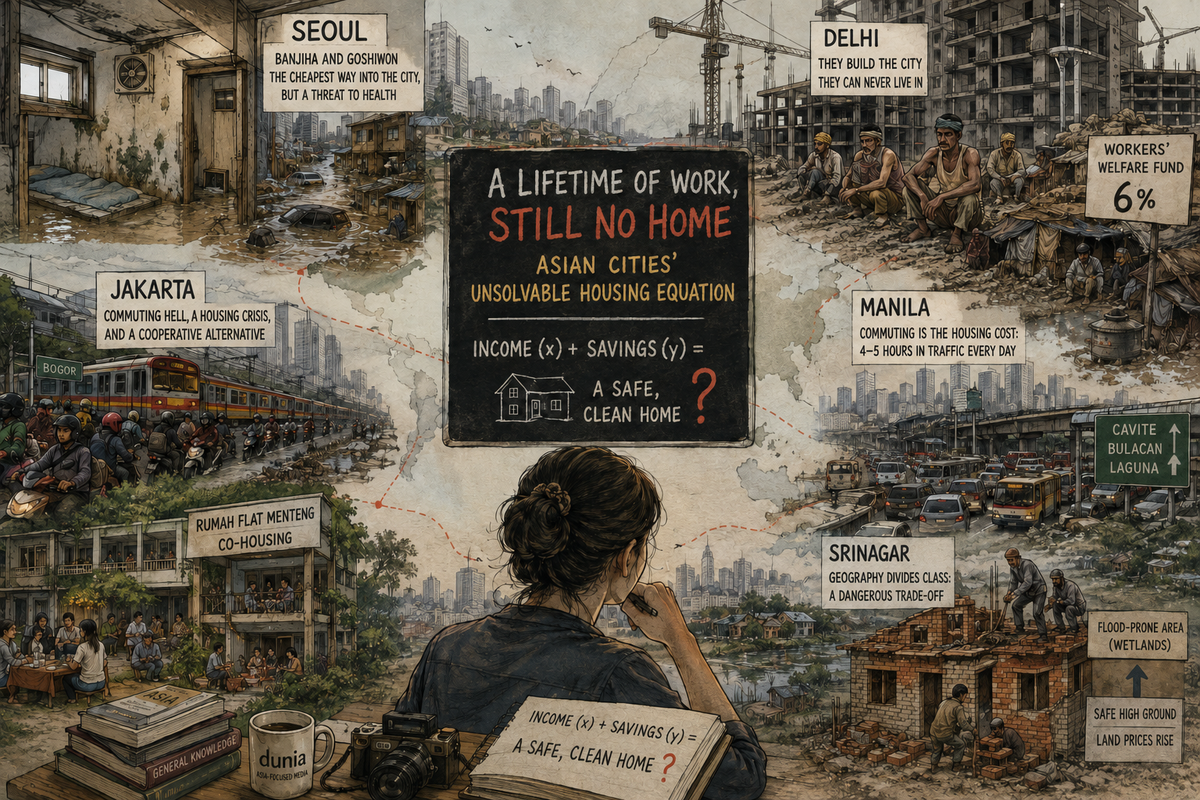
Semi-basement apartments and goshiwon, cooperative co-housing, temporary shelters for construction workers, commutes that swallow entire afternoons, and self-built homes in flood-prone terrain — the forms differed, but underneath them all sat the same broken equation: income plus savings should equal a safe, clean home. That simple formula is rarely balanced, in any Asian city we visited.
This series is an attempt to work through that unsolved equation across six cities, and six lives. Starting this week, the following six articles will be published as part of the series.
Jakarta appears in this series as both a symptom and a solution. One story follows workers pushed to the city's outer edges: even an ordinary office worker earning the median monthly wage of 6 million rupiah finds that a modest apartment near the city center now costs more than a decade of savings, and spends hours each day on a motorbike or commuter train just to get to and from work. The other story follows people who found their own answer in that same desperation: Rumah Flat Menteng, a cooperative co-housing project in central Jakarta, built without a developer, funded through a 70-year land lease and residents' pooled capital. The project has drawn more than 2,000 applicants for future phases, and sparked similar conversations in Bandung and Yogyakarta.
In Delhi, the equation takes its cruelest form. An estimated 800,000 to a million migrant construction workers build the luxury residential towers they will never be able to afford to live in. Paid below minimum wage, they live in makeshift shelters that trap heat above 47°C in summer and flood with sewage during the monsoon and of the welfare fund legally set aside for their benefit, barely six percent actually reaches them.
Manila is a city where the commute itself has become a form of housing cost. With condo rents running as high as 141% of median household income, even white-collar workers are pushed out to peripheral provinces like Cavite, Bulacan, and Laguna, trading four to five hours a day to traffic.
Srinagar is a place where geography itself draws the lines of class. Residents earning between ₹10,000 and ₹25,000 a month build their homes incrementally, adding rooms over decades as they can afford rising material costs. Since the catastrophic 2014 Jhelum River floods, land prices on safer high ground have soared, pushing lower-income families onto flood-prone wetlands, trading affordability for safety.
In Seoul, the banjiha is where the story begins. Originally built as mandatory air-raid shelters during wartime, these semi-basement units offer the cheapest foothold into the capital's brutal housing market, but they exact a steep "health tax": mold, radon exposure, and chronic sunlight deprivation that add up to lasting illness. The record-breaking downpour of 2022 delivered a brutal proof of what that cost can ultimately be sometimes, a life.
More from the series | Housing in Asia
Prologue – Asian Cities’ Unaffordable Housing Equation
Part 1. – Jakarta’s Impossible Home, What Housing Really Costs in Indonesia’s Capital
Part 2. – Jakarta's USD 18,800/m² District Gets a Housing Experiment
Part 3. – The Invisible City: Life Beneath Delhi’s Rising Skyline
Reporting Seulki Lee (DUNIA Editor-in-Chief, Journalist) – skidolma@thedunia.org