Jakarta's USD 18,800/m² District Gets a Housing Experiment
By Muhammad Ishomuddin
- Land prices in Jakarta's upscale Menteng district have soared to nearly $18,800 per square meter, pushing the middle class toward substandard rentals or crushing loans.
- Architect Marco Kusumawijaya built "Rumah Flat Menteng," a resident-cooperative co-housing project on his own land, blocking speculation by treating housing as a right to be saved for and returned rather than owned.
- Far cheaper than market rate and with easy transit access, the model has earned high resident satisfaction and drawn 2,000 waitlisted households, spreading to cities like Bandung and Yogyakarta.
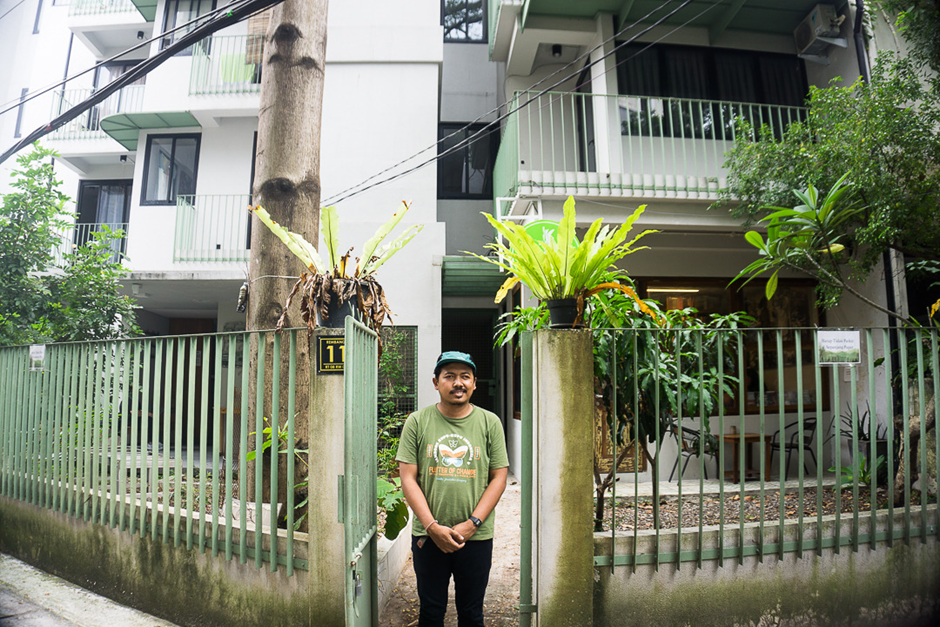
Jakarta — A small, faded yellow banner reading "House for sale, no agents, contact immediately" hangs on the front fence of a house, dwarfed by the taller buildings around it. Banners like this are a common sight on the way to Rumah Flat Menteng. The co-housing complex sits set back from the main road, down an access lane so narrow that two cars can barely pass each other.
Land prices in Menteng, an upscale district in central Jakarta, are notoriously steep. Prices currently run close to IDR 100 million per square meter (around USD 18,800), with home prices ranging from the billions to the hundreds of billions of rupiah.
Yet the middle class remains stuck, trapped in substandard rental rooms or poorly located apartments, or burdened by mortgages just to buy a standalone house.
Rumah Flat Menteng is a four-story co-housing building erected on this same patch of expensive Menteng real estate, built by architect Marco Kusumawijaya on his own private land, without any involvement from the government or a developer.
Residents formed their own cooperative to lease the land for 70 years and lead construction and management themselves. The project applies the concept of "Missing Middle Housing" — a term coined by American architect Daniel Parolek — to fill the gap between standalone houses and high-rise apartments, positioning itself as an alternative housing model.
"A Home for Everyone" Marco's Long-Held Vision
In 2020, Marco Kusumawijaya decided to finally realize a vision he'd held since the late 1990s, when he first acquired roughly 280 square meters of land in Menteng. He set out to build a four-story co-housing building where people he knew could live together.
To develop the concept, he partnered with the Rujak Center for Urban Studies (RCUS), an urban research and advocacy organization based in Menteng. Architect Andesha Hermintomo led the building design.
The process wasn't easy. Alongside the design and construction, the project required sustained public outreach to build awareness around this experimental housing model. The result, Rumah Flat Menteng, became Indonesia's first co-housing project to comply with the 2022 Governor's Regulation No. 31 on Jakarta's detailed spatial planning.
Construction began in 2023, and residents moved in by early 2025. Built on a 250 square meters plot, the 408-square meter building holds six units across its second through fourth floors, with an office, rental space, and a bookstore-café on the ground floor. Six households — 17 residents in total — currently call it home.
Buying Not a House, But "the Right to Live There"
The building's ownership and operating structure is equally unusual. At the heart of Rumah Flat Menteng is a design that separates ownership from management, specifically to prevent speculation.
The land title remains in Marco's name, but the resident cooperative holds a land-use right and manages the building itself.
Residents lease Marco's land at an annual rate of IDR 90 million (about USD 5,160), on a renewable 70-year term. The rent varies based on the size of each resident's unit, and by prior agreement, rent is adjusted every five years to account for inflation.
Construction costs paid by residents aren't treated as a purchase price but as "mandatory savings", fully refunded when a resident moves out after living there for at least five years.
Construction costs for Rumah Flat Menteng were kept under IDR 8 million per square meter (about USD 455), far below the roughly IDR 11.6 million per square meter (about USD 665) it typically costs to build a four-story building in Jakarta. The upfront capital required ranges from IDR 380 million (about USD 21,770) for the smallest unit (40 square meter) to IDR 1 billion for the largest (120 square meter).
Residents split these construction costs, which are treated as mandatory savings paid into the cooperative along with notary fees and shared facility construction costs. Residents also take part throughout the construction process, adjusting the building's physical design to fit their needs, within the bounds of safety standards.
Rumah Flat Menteng represents a concrete attempt to redefine housing, not as an asset to be bought and sold, but as a right to live somewhere, paid for through savings and returned in kind. This is what sets the model apart: it structurally blocks both speculative resale profit and rent hikes.
The management model draws inspiration from Kampung Susun Akuarium in North Jakarta, which was built on government-owned land but is managed by a resident cooperative. Rumah Flat Menteng differs in that it sits entirely on private land, built and run through residents' own voluntary cooperative with no government involvement at all.
The residents' governing body, the Rumah Flat Menteng Multipurpose Cooperative (Koperasi Serba Usaha Rumah Flat Menteng), works with residents to draft agreements collaboratively. Residents participating directly in construction and management, keeping developers out of the picture entirely, is central to how the cooperative operates.
Cutting Both Commute Time and Cost
Residents' quality of life has improved significantly since moving into Rumah Flat Menteng.
Located in the heart of Jakarta, the building sits close to Sudirman station and stops for the commuter rail, MRT, LRT, and TransJakarta bus lines, letting residents get by comfortably without owning a car or motorbike.
For Andi Hardiansyah and Famega Syavira Putri, a couple living there, monthly transportation costs dropped sharply from IDR 5 million (about USD 290) to IDR 700,000 (about USD 40) alongside a major cut in commute time.
Andi, who works at an NGO, said that even with a house and a deed of ownership, living far away, where commuting costs keep adding up every time you travel, is worse. He called it a waste of time and energy.
Famega, who works as a social media lead at BBC News Indonesia, now walks just 15 minutes to her office, down from nearly an hour by public transit from her previous home. Saving money has become far easier for the couple. Andi added that they now have more free time to handle various tasks and to spend quality time together.
The building's community atmosphere also adds to residents' satisfaction. Rules residents set together around designated smoking areas, a large shade tree on the front terrace, and regular book discussions held at the ground-floor bookstore-café all contribute to the building's lively communal culture.
Spreading Beyond Jakarta to Bandung and Yogyakarta
The Rumah Flat Menteng model has drawn strong interest from both landowners and young, unhoused households.
In response, RCUS began accepting registrations for follow-up projects. Landowners must first approve RCUS's design concept, then go through site surveys, environmental assessments, title verification, and permitting. While roughly 2,000 households applied, only around 40 units were actually planned for construction. RCUS selected only those who properly understood the concept and could follow through on it.
In 2026, RCUS signed contracts for eight flat projects across Jakarta, three of which are set to begin soon. One site, in the Pancoran district of South Jakarta, was originally slated for sale, with the proceeds to be split among three heirs.
After learning about Rumah Flat Menteng, the family pivoted to an alternative plan: each child would inherit one unit, while the parents would continue collecting rental income from the land. As selling real estate assets grows increasingly difficult, this became a practical win-win solution for the landowners.
Interest in the model has spread well beyond Jakarta. The Labtek Indie community in Bandung, West Java, conducted a joint case study, while Studio Tanah in Yogyakarta held a discussion forum with the "Klub Mencari Tetangga" (Neighbor-Finding Club) to address urban living challenges. Studio Tanah had already built a 13-household eco-friendly co-housing project called "Samadya Co-housing" back in 2022, and recently held a launch event for a book documenting that experience.
Toward an Alternative for Everyone, Not Just the Middle Class
For decades, Indonesians have viewed homeownership as a marker of success, and urban real estate has been valued more for its commercial worth than its contribution to quality of life. A segment of the ultra-wealthy own multiple homes purely as investments, rather than renting them out, fueling market disruption.
Against this backdrop, Rumah Flat Menteng stands out as a potential alternative for the middle class, but it still requires at least a decade of stable income and sufficient upfront savings. It's not an experiment accessible to everyone; there's still a barrier to entry, and this is precisely where government support is needed for lower-income or financially unstable households.
A year after move-in, some design oversights have also surfaced: the lack of a passenger elevator, dangerously wide gaps in balcony railings, poorly placed light switches, and leaks caused by inadequate waterproofing, all stemming from insufficient construction oversight. Andi emphasized that quality control needs to be far stricter going forward, since every detail matters for residents' safety and comfort.
Even so, Rumah Flat Menteng has proven that residents working together can secure decent-quality housing at a fraction of market price. RCUS plans to apply more rigorous planning to future projects. Andi believes the concept could be replicated in any Indonesian city. The formula stays the same, he said, even if the challenges each city faces will differ.
More from the series | Housing in Asia
Prologue – Asian Cities’ Unaffordable Housing Equation
Part 1. – Jakarta’s Impossible Home, What Housing Really Costs in Indonesia’s Capital
Part 2. – Jakarta's USD 18,800/m² District Gets a Housing Experiment
Part 3. – The Invisible City: Life Beneath Delhi’s Rising Skyline
Reporting Muhammad Ishomuddin - muhishom@protonmail.com
Muhammad Ishomuddin is a freelance journalist and photojournalist from Indonesia who focuses on covering environmental issues and human-interest stories; his work has been published in VICE and New Naratif.
Translation and Editing Seulki Lee - skidolma@thedunia.org