🍏 <Dunia Letter> - No. 13
Dear DUNIA supporters and newsletter subscribers,
This is Seulki Lee, founder and director of DUNIA. This is the first time I am writing to you through our newsletter since we published our launch investigation on November 7, 2025. From time to time, I have found myself quietly reading through the names of our 75 sustaining supporters and the email addresses of our 42 newsletter subscribers.
When I started an independent, reader-supported media outlet, one piece of advice I heard again and again was: “Don’t bother your supporters.” For the past ten months since our launch, I have actually found it a little difficult to hold myself back from reaching out and talking to you. But I came to feel that, at least once a month, I should write to those of you who sustain DUNIA, believe in what we are trying to do, and have chosen to be part of it, and to tell you what is on my mind as we build this world called DUNIA together. And because we are trying to open a path that no one has quite taken before, I also feel a responsibility to leave a record of this journey that we can look back on together. So from now on, I will write to you once a month.
How have you all been? I hope you are staying strong and finding moments of joy amid the changing weather, the moods that shift with it, and all the things that still have to get done. Since returning to Seoul after two weeks of field reporting in Myanmar this May, I have been recovering from a period of burnout. On the surface, it seemed to come from the financial pressure of reporting costs. Looking back, though, I think the real reason had less to do with money than with a question that kept returning to me: Am I doing this the right way?
The two weeks I spent in Myanmar were filled with tension and stress. We frequently changed interview locations to protect our sources, and we had to go through what they had told me sentence by sentence, deciding together how much could safely be made public. People who had left their jobs in resistance to the coup, and people who had endured detention and torture, told me that even if they had to speak under pseudonyms, they wanted their stories to reach Korea, to reach beyond Myanmar. One source, who lost a sibling amid the bloodshed following the coup and still lives with the trauma of what happened, told me, “We can never forget what we saw.”
But once I returned to Seoul, sorting through receipts and sitting with my drafts, another question kept surfacing: What does it mean to write these stories in Korean for the people who entrusted them to me, and for all of you reading them? Does it make sense to keep traveling so far, taking on so much expense and risk to report these stories? Would it be better to focus instead on the work I can do from Seoul?
I still do not have a complete answer to that question. But as I recovered, one thing became clear. DUNIA does not report on Asia simply to tell stories about “terrible things happening in faraway places.” Korean capital, weapons, policies, and indifference leave their marks somewhere in Asia, and those consequences eventually find their way back into our own lives. I started DUNIA because I wanted to go there myself, see those connections, document them, and bring them into view. And I have also come to understand that no one else is simply going to do this work for us.
So I have decided to keep going. But not by trying to endure everything alone. I want to find a way of doing this work that allows us to keep going for much longer. The Myanmar reporting that I had been wrestling with for so long finally began running as a series this month. (▶ Myanmar’s Coup Leader Is Now President: 14 Days of Reporting on the Ground)
And this November will mark one year since DUNIA came into the world. To mark our first anniversary, we are organizing a public forum titled “Rebuilding Between Resource Extraction and Consumption | Connecting Dots for Greener Asia”. On October 24 and 25 in Seoul, we will be joined by Indonesia’s documentary media collective Watchdoc and grassroots development justice organization PUSAKA to discuss resource extraction, corruption, and the crisis of democracy in Indonesia.
Since this is also DUNIA’s first-anniversary gathering, we are preparing it with the hope that we will finally get to meet many of you, our supporters and newsletter subscribers, in person. You can register to attend here.
And one more thing before our anniversary forum: on October 9, Hangeul Day, DUNIA will have a booth at the Bisang Flea Market. From 11 a.m. to 5 p.m. at the Museum of Japanese Colonial History in Korea (27 Cheongpa-ro 47da-gil, Yongsan-gu, Seoul), we will be selling a small book made by DUNIA. Proceeds will go toward ongoing fundraising for Gaza organized jointly by ADI and the Korean Civil Society Emergency Action in Solidarity with Palestine.
If you have thoughts that came to mind while reading DUNIA, questions you have wanted to ask, things you wish we had done differently, or if you simply want to tell me how you have been lately, please feel free to write. Behind those 75 names and 42 email addresses are real people, and I would love to hear your voices. You can reach me at skidolma@thedunia.org.
I will write again next month.
Warm Regards,
Seulki Lee
Founder & Executive Director
DUNIA
🎤 October Event | Connecting Dots for Greener Asia
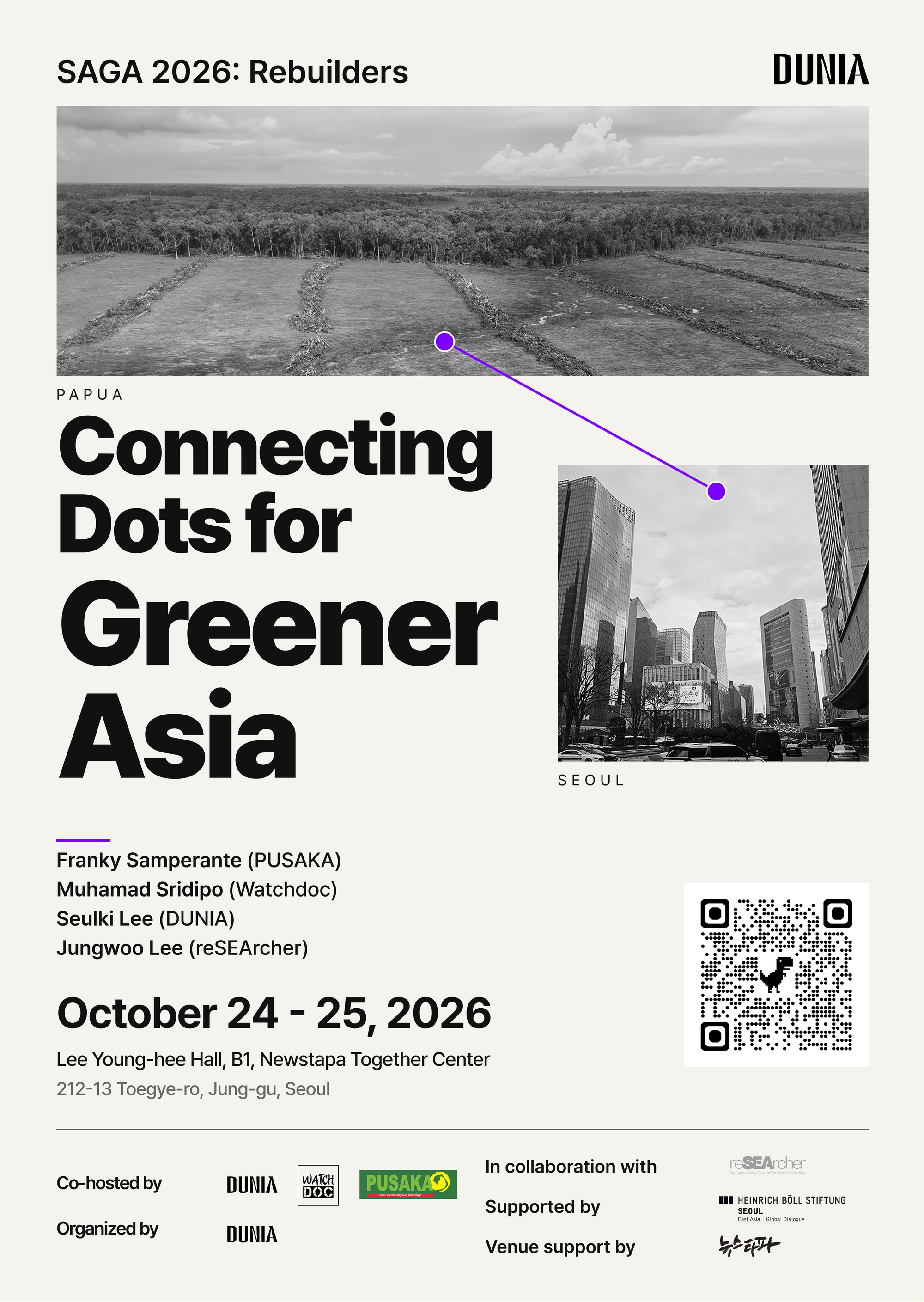
On October 24–25, DUNIA will host 2026 Rebuilders: Connecting Dots for Greener Asia in Seoul.
For this event, we are bringing together Franky Samperante of PUSAKA, who has been monitoring land grabbing and deforestation in Papua, Indonesia, and Muhamad Siridipo of Watchdoc, an independent media outlet that has challenged censorship through investigative journalism and innovative ways of bringing its work to the public.
From land rights and resource development in Papua to the links between Korean corporate investment and deforestation in Indonesia, and from investigative journalism that holds power to account to the role of alternative media, the event will bring together experiences and practices that have emerged from different fronts.
But this will be more than a series of presentations. Together with our two speakers, we will ask what it takes for documentation from the ground to become journalism, and for journalism, in turn, to lead to civic action and solidarity across borders.
Day One will feature sessions with both speakers as well as a screening of Watchdoc's documentary Pesta Babi. Day Two will bring the speakers together for the Connecting Dots Roundtable.
DUNIA readers are also invited to join us in the audience. We welcome anyone interested in environmental and land rights issues in Asia, investigative journalism and independent media, and solidarity across borders.
- Date: October 24–25, 2026
- Venue: Lee Young-hee Hall, B1, Newstapa Together Center (212-13 Toegye-ro, Jung-gu, Seoul)
→ Register: Link
🧑🤝🧑 Interview Series | I Am a First-Generation Asian Migrant
- Episode 1: Sunwoo Kang (Myanmar)
- Episode 2: Eiman (Afghanistan) — Coming in October
🔎 Asia's Housing Equation
- Prologue — Asian Cities’ Unaffordable Housing Equation
- Part 1 — A Decade Just to Pay Off the Down Payment: The Reality of Homeownership in Jakarta
- Part 2 — Jakarta's USD 18,800/m² District Gets a Housing Experiment
- Part 3 — The Invisible City: Life Beneath Delhi’s Rising Skyline
- Part 4 — Coming in October
🌏 Nepal–Tibet Flood
- Central Nepal flood, the day after
- More clues about the Nepal-China flood
- Heartbreak and hope go together in Nepal
- The Flood South Asia Saw Coming
📚 DUNIA Book Club Reviews
- Review of Vijay Prashad’s The Darker Nations: A People's History of the Third World: What If the "Third World" Was Never About Being Third-Class, but About Imagining a Third Path?
- Review of Vincent Bevins' The Jakarta Method
- Review of Elizabeth Pisani's Indonesia Etc.: Why I Love Indonesia
💬 Closing
Over the past few months, DUNIA has been moving from one story to another—reporting from across Asia, meeting new people, and finding new ways to tell the stories we encounter. We are glad to finally share with you the articles, videos, and voices that have accumulated along the way.
Today is Chuseok, Korea’s harvest holiday. To everyone who reads DUNIA, shares our work, supports our reporting, and stays with us along the way: thank you. Wherever you are and whoever you are spending the holiday with, we hope you find some time to rest and enjoy a peaceful break.
After the holiday, DUNIA will head back to the field. From Connecting Dots for Greener Asia in October to the many stories from across Asia that we have yet to tell, there is much more to come.
We look forward to seeing you again in the next DUNIA Letter.
Thank you for being with us.
🗂 Contact & Inquiries
- Website: dunia-asia.org
- Inquiries: contact@thedunia.org
- Phone: +82-10-6309-0097
- Address: Unit 409-Ja10, 168 Gwanak-ro, Gwanak-gu, Seoul, South Korea
- One-time Donations via transfer: Shinhan Bank 140-016-517683 (DUNIA / Seulki Lee)
- One-time Donation via Wise: Link